|
On December 9, Carroll Institute transitioned to a new online administrative interface. Registration for the Paschal Term 2011 is in progress. Account Services' new interface is more user friendly and brings many improvements that benefit students, faculty, and staff. Any system changes bring with it a period of adjustments and learning new features. Carrolls' administrative staff appreciates your patience during this time of transition.
|
|
Archive of Previous Issues
Look for us on 
|
|
www.facebook.com/carrollinstitute
|
|
|
Carroll Institute hosted a come-and-go open house on Tuesday, December 14 from 10 a.m. to 4 p.m. for friends to see the new office location on the first floor of the Charles Wade Building of First Baptist Church Arlington. The visitors were given a tour of the facility, visited with faculty and staff, and enjoyed delicious refreshments. There was indeed a festive Christmas mood with the lovely decorations and Christmas carols being played in the background on the Institute's Steinway grand piano. Sixty-five people attended the event throughout the day. If you were unable to attend the open house, Carroll Institute invites you to drop by any time.
|
|
January 10 - March 4
Registration is open.
|
|
|
Carroll Institute's self-study will be reviewed by ABHE's Commission on Accreditation during its annual meeting in February. Pending the approval of the self-study, a site visit has been scheduled for April.
|
|
|
Please note that to qualify as a 2010 tax deductible contribution, year-end gifts must be postmarked on or before December 31. Any contributions bearing a January postmark will be considered a 2011 contribution. Gifts to Carroll Institute may now be processed electronically by contacting the Bursar:
email - bmuskrat@bhcti.org
fax - 817-274-2226.
|
|
|
ONLINE COURSES DEALING
WITH ORALITY STUDIES
Dr. Grant Lovejoy, coordinator of Orality Strategies (International Mission Board, SBC) will be offering two online courses during the Spring of 2011. Missionaries and others not currently enrolled in BHCTI may participate in the class. Registration is now open for the Paschal Term course "Narrative in Biblical and Cultural Contexts."
"Our lives must find their place in a greater story... or they will find their place in a lesser story." H. Stephen Shoemaker
Cultural stories shape people’s lives, often in ways that people hardly realize. Through conversations, family
gatherings, religious activities, history lessons, books, music, TV, movies, or other means, stories tell us (directly or indirectly) who we are and who we could become. They tell us what to expect from the world, and what we should expect of ourselves. Such stories can encourage us to believe that good is ultimately rewarded--or that no good deed goes unpunished.
The storytellers are the gatekeepers of a culture’s values, beliefs, and behaviors. Through them the society learns, reinforces, and revises its identity and its dreams. Most of us live out our perceived role in a grand story that consists of the overarching mythology taught by our culture, the “tribal” story taught by our ethnic or socio-economic subgroup, the family story we learned from our relatives, and other appealing stories offered by the media, teachers, and friends.
Above all cultural stories stands God’s story as revealed in the Bible. God’s story offers an alternative account of who we are, what the world is like, why we are here, and what we can become in this life and beyond. By believing God’s story, we find our true selves and our place in his greater story. We understand the world better when we view it as Scripture tells us it actually is. We no longer need to build our lives on the distortions and outright falsehoods of cultural stories devoid of God’s truth. The power of God’s Grand Narrative becomes especially evident when we present it as a narrative.
“Narrative in Biblical and Cultural Contexts” explores both the overarching biblical narrative and various cultural narratives. Participants will explore their own culture’s worldview and/or study another culture or subgroup, such as ethnic minorities in their community or an overseas group where they plan to do ministry. The course explores the biblical Grand Narrative and identifies its distinctives compared to other religious and non-religious narratives. It discusses how to introduce individual biblical stories, selected groups of biblical stories, and the larger biblical narrative alongside alternative cultural stories as a way of clarifying differences and offering people the life-giving, hope-inspiring biblical alternative. Participants will be introduced to dozens of collections of biblical stories chosen for use in a wide variety of Christian ministries, such as cross-cultural church planting, home discipleship groups, ESL classes, community health empowerment initiatives, and outreach to post-modern young adults.
“Narrative in Biblical and Cultural Contexts” provides the foundation for the second course, “Using Biblical Storytelling in Church and Community,” which will be offered during the Omega 2011 Term: April 4 - May 27. More details on that course will follow in a future newsletter.
|
 CARROLL INSTITUTE HOSTED TWO DISTINGUISHED PROFESSORS OF PHILOSOPHY AT WINTER COLLOQUY CARROLL INSTITUTE HOSTED TWO DISTINGUISHED PROFESSORS OF PHILOSOPHY AT WINTER COLLOQUY
|
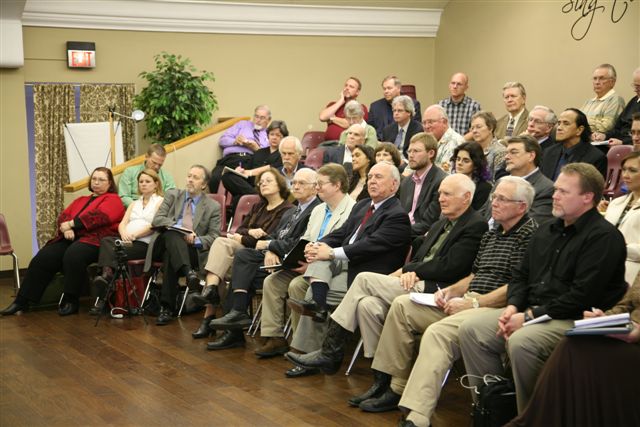
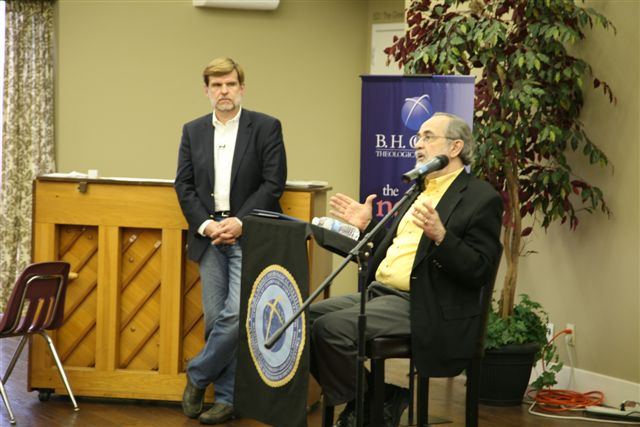
Henard E. East Hall of First Baptist Church, Arlington, TX, was the site of Carroll Institute’s Winter Colloquy series. Approximately sixty people, including BHCTI faculty and staff , PhD and DMin students, and guests attended the lectures featuring Dr. Merold Westphal (Fordham University)
and Dr. Keith Putt (Samford University).
Mr. Don Day, BHCTI Director of Library and Information Services and Fellow & Lecturer in Philosophy of Religion, offers the following reflections on the Winter Colloquy: 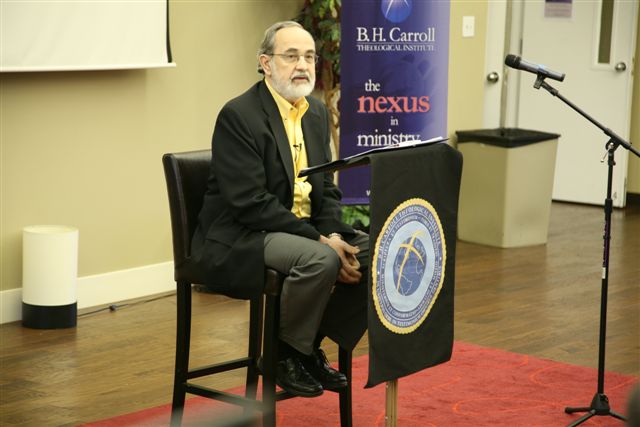 "The Winter 2010 Colloquy title posed the question, ‘Postmodern "The Winter 2010 Colloquy title posed the question, ‘Postmodern
Philosophy: Friend or Foe?’ The answer was not so obvious as might first be thought. Jesus encourages us in Luke 6:35 to love enemies, and do good to them; and while some well known thinkers counted in the postmodern camp are foes to God (Nietzsche and Focault being two), we ought also to consider Kierkegaard a friend to faith, and a significant informer to the thought of contemporaries like Jack Caputo and presenters Drs. Merold Westphal and Keith Putt.
In view of the widespread disenchantment with the results of the quest for objective certainty, championed by Descartes and others in his train, we might confess theologically our human fallen-ness, and understand that
while we cannot see the whole of God’s perspective from our own finite place, we bring something of great significance in our presentation of the Gospel. We do not merely bring an objective perspective based on what the Bible has said to its first hearers; we are uniquely placed to speak God’s message to our particular context in time, based on that first perspective.
A theme of ‘perspectival pluralism’ pervaded in presentation; ours is not the final perspective on God’s word, and though others have proceeded and may follow, the Gospel speaks to us and through us in the present tense. Rather than shoehorning the God of the Bible onto the philosophical model of the Prime Mover, we can accept or reject the God of the Philosophers on the basis of the Bible, centered on the Christ as
God’s truest portrait.
We can choose wisely among the thinkers and writers in a post-modern mode, and draw close to them not merely to grapple, but to teach, learn, and grow. "
|
|