February 2022 NAAFA Newsletter |
|
|
Black History Month and Black History Always
by Tigress Osborn |
|
|---|
|
Black History Month is celebrated in the United States throughout the month of February. What started as Negro History Week in1926 grew into Black History Month in the '60s as Black Pride and Civil Rights movements increased in the U.S. and across the African diaspora. Black History Month was eventually adopted in 1976 as an official U.S. celebration.
The first time I remember knowing about Black History Month, I was a first grader in a small town, Arizona public school in 1980. There was one other Black student in my class. We were two of only a handful of Black kids in the entire school. I remember taking
Ebony magazines to school, but I don't remember what we did with them. The next clear memory I have of honoring Black History Month was in high school.
Ebony magazine was a star player once again, as I cut up issue after issue to make collage posters of important Black people to hang all over my school. Some of them were famous athletes and movie stars my classmates would recognize; some were inventors and scholars and people none of us would ever have been exposed to in mainstream media. Those "unknown" heroes were known to some Black folx. They were the reason magazines like
Ebony existed--so we could see reflections of ourselves when other media either couldn't be bothered or explicitly kept things mighty white.
Later, I would become devoted to
Essence and its portrayals of beautiful Black women and femmes. Even later, I would discover magazines like
Belle Noire that featured plus-size sistas. But at the time of my first forays into planning Black History Month visibility campaigns to educate my adolescent peers, my favorite magazines were the ones aimed at teenage girls,
Seventeen and especially
Sassy. They occasionally featured Black girls and other people of color, and
Sassy even named a Black girl the "Sassiest Girl in America." But for the most part, they were assumed to be race neutral, which in the world of early '90s publications (and most media to this day) actually means white-centered.
Sassy had a monthly column called "Stuff I Wrote" and it included lots of one-liners, jokes, and quippy thoughts, the kind of things we'd see as tweets today. I remember the day my heart sank when, amongst the witty wonderings in the one magazine I thought was closest to understanding my coming-of-age heart, I saw something along these lines: "Why do they get to have
Ebony magazine? Wouldn't it be racist if we had
Ivory magazine?" At the time, I didn't know how to articulate my disappointment. Now I do: for the most part, I was reading
Ivory magazine every month on their pages. How dare they blame Black people for having the audacity to carve out a space for our stories when all they did most of the time was maintain a space for theirs?
Now, I'm a middle-aged Black mixed-race woman. I have a degree in Black studies; I spent years working with Black and POC youth; for a decade, I ran a Black-centered plus-size nightclub event. I've been a fat activist for about 14 years. In all those spaces, the number of times I've seen and heard resentment about Black-centered
anything from White people who exist at almost all times in white-centered
everything is outrageous. Throughout my life I've heard the same argument about Black History Month that some random teen writer penned for "Stuff You Wrote." It goes like this: "If they get to have Black History Month, why don't we get to have White History Month?"
To continue reading, go to www.naafa.org/blog |
|
|---|
|
|
|
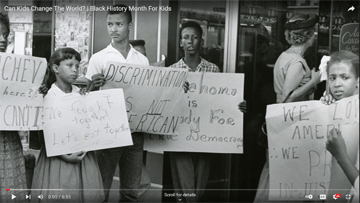
Can Kids Change the World?
They may be small but their actions can be mighty. In 1958 a group of Black children from OK visited NYC and experienced a whole different world. They preferred life without the discrimination they were experiencing at home so they decided to change their part of the world.
youtube.com/watch?v=8b3Y9xVvQzw |
|
|---|
|
Health At Every Size and HAES are registered trademarks of the Association for Size Diversity and Health, and are used with permission.
|
|
|---|
|
|
|
|---|
|
|
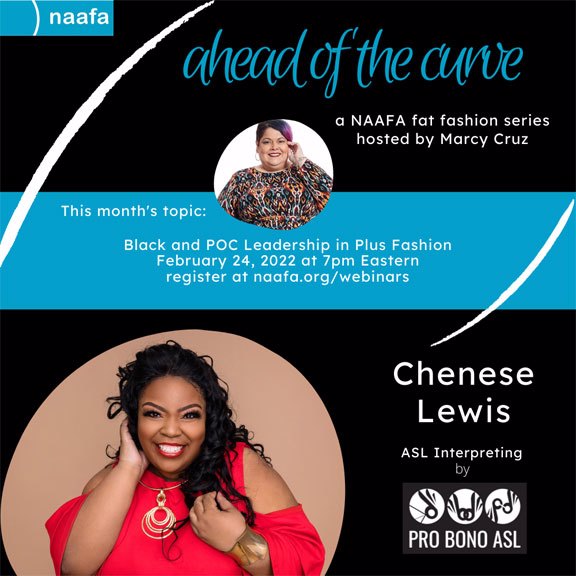
AHEAD OF THE CURVE featuring Chenese Lewis, hosted by Marcy Cruz
BLACK AND POC LEADERSHIP IN PLUS FASHION
Thursday, February 24, 2022 at 4pm PT/5pm MT/6pm CT/7pm ET
In this edition of Ahead of the Curve, Chenese and Marcy will discuss how Black Women/Women of Color paved the way in the fashion industry for plus size bodies to be in the forefront and continue to push for size inclusivity.
Accessibility notes: This webinar is presented in English with closed captioning by Otter.ai and ASL translation is provided by Pro Bono ASL. |
|
|---|
|
Anti-Racism Resources Celebrating Black History Month 2022
compiled by Darliene Howell
|
|
|---|
|
This month, for the educational resources feature on the NAAFA Community Voices Blog, we focus on Black History Month 2022 whose theme is Black Health and Wellness.
INFORMATION ABOUT BLACK HISTORY MONTH
Video
How a former enslaved person helped make Black History Month a national celebration - CBS Saturday Morning
President Abraham Lincoln signed the 13th Amendment and abolished slavery on February 1, 1865. That date would eventually lead to the Black History Month we celebrate each year, thanks in part to the efforts of a formerly enslaved person, Richard Robert Wright Sr. Michelle Miller explores how Wright's own life story is just what this month is meant to honor.
Carter G. Woodson - biography.com
1875 - 1950
Carter G. Woodson was an African American writer and historian known as the 'Father of Black History.' He penned the influential book
The Mis-Education of the Negro.
Black History Month has a theme…who knew? By Candice Marie Benbow
If you weren't aware, Black History Month as celebrated in the U.S. has a theme each year. For 2022, the theme is "Black Health and Wellness."
The history of African Americans and organized medicine - ama-assn.org
The AMA Institute for Ethics invited a panel of experts to review and analyze the historical roots of the black-white divide in American medicine.
BLACK AMERICANS IN MEDICINE
Meet Onesimus, The Enslaved Man Who Saved Colonial Boston From Smallpox by Kiona N. Smith
Boston, 1721 - A smallpox epidemic that killed thousands is stopped thanks to a slave of a minister when he shared how to inoculate people against the disease.
Dr. James McCune Smith by Dr. Karen Winkfield
1811 - 1865
James McCune Smith was the first university-trained Black physician to practice medicine in the U.S.
Dr. Rebecca Lee Crumpler - National Women's History Museum
1831 - March 9, 1895
Dr. Crumpler was the first African American woman to receive a Medical Degree (MD) in the U.S.
Mary Eliza Mahoney - National Women's History Museum
1845-1926
Mary Eliza Mahoney was the first Black professional nurse in the U.S. (1879).
Dr. Daniel Hale Williams - biography.com
1856 - 1931
Dr. Daniel Hale Williams was one of the first physicians to perform open-heart surgery in the U.S. and founded a hospital with an interracial staff.
Dr. Charles Richard Drew - biography.com
1904 - 1950
Dr. Charles Drew was an African American surgeon who pioneered methods of storing blood plasma for transfusion and organized the first large-scale blood bank in the U.S.
David Satcher, MD, PhD - Perspectives of Change
March 2, 1941 - Present
First African American named to head the CDC, and first African American man named U.S. Surgeon General, Health and Human Services.
Kizzmekia S. Corbett - The Franklin Institute Awards
Dr. Kizzmekia Corbett led a team that developed the COVID-19 vaccine and has been awarded the Benjamin Franklin NextGen Award. Citation: For her outstanding contributions to the field of viral immunology and vaccine development, including an mRNA-based vaccine to combat the novel coronavirus SARS-CoV-2, cause of the COVID-19 pandemic.
This is, by no means, a complete list of the Black men and women that have contributed to the health and wellness of all Americans. Nor does it address the inequities in healthcare for Black Americans. We salute all of the Black doctors, nurses, and other healthcare practitioners that are using their brilliant minds and giving their talent to making a difference in our health.
If you have the ability to do so, please consider donating to local or national organizations that are working to bridge the healthcare gaps for minority populations. |
|
|---|
|
Decolonizing Wellness Book Giveaway!
|
|
|---|
|
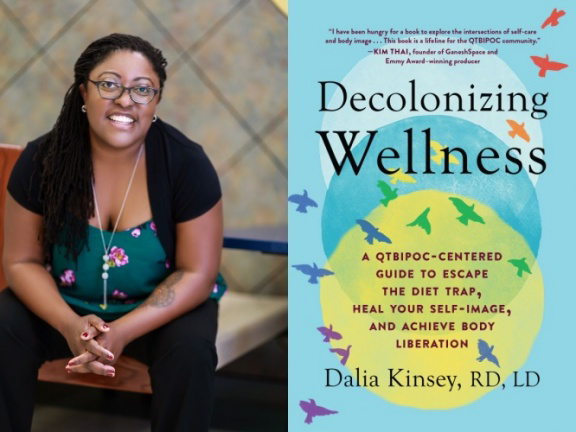
Dalia Kinsey (Nonbinary | No Pronouns) is a queer, small fat, Black Registered Dietitian, the creator of the Body Liberation for All podcast, and author of
Decolonizing Wellness: A QTBIPOC-Centered Guide to Escape the Diet Trap, Heal Your Self-Image, and Achieve Body Liberation. Dalia, along with co-panelists Lindley Ashline and Laura Burns, recently joined us on the NAAFA Webinar Series to discuss how fat business owners can be supported and how other businesses can better support fat customers. (That episode will be available soon on our YouTube channel. Be sure to subscribe to NAAFAOfficial on YouTube for this and educational videos!)
Dalia rejects diet culture and teaches people to use nutrition as a self-care and personal empowerment tool to counter the damage of systemic oppression. Dalia and Dalia's publishers are giving away a free copy of the book to someone in our NAAFA community. Click here to enter the giveaway! Enter by 2/28/2022. More of Dalia's work can be found at daliakinsey.com.
|
|
|---|
|
Media and Research Roundup
by Bill and Terri Weitze
|
|
|---|
|
May 23, 2021: A Culture Study article talks about the pervasiveness of the "ideal body" in teen magazines, how fat liberation has helped change this, and how much still stays unchanged.
https://annehelen.substack.com/p/the-millennial-vernacular-of-fatphobia
January 17, 2022: All Fired Up podcast talks with Ragen Chastain, who discusses fat related myths, focusing on the idea that a 5-10% weight loss alone significantly changes a fat person's health.
https://untrapped.libsyn.com/5-10-weight-loss-is-good-for-your-health-other-bs-with-ragen-chastain
January 28, 2022: More-love.org sells cards for patients who prefer not to be weighed when visiting the doctor and cards for parents who don't want their children to hear discussions about weight. The cards may help avoid triggering moments and shift focus away from weight.
https://www.self.com/story/dont-weigh-me-cards/amp
January 31, 2022: Taking focus away from the body's appearance and respecting what each body can do makes body neutrality a powerful tool to fight fat bias, as body neutrality becomes an alternative for body positivity, which is being co-opted by the wellness industry.
https://mashable.com/article/how-to-practice-body-neutrality
February 1, 2022: Athia N. Choudhury traces the roots of thin-rage, especially as to fat black bodies, back to historical power, whiteness, and coloniality.
http://foodfatnessfitness.com/2022/02/01/thin-rage-and-racialized-fat
February 1, 2022:
Fat Studies invites submission of papers for consideration its July 2022 conference Fat Studies: Rights, Personhood, Disposability. Abstract submission deadline is March 1, 2022.
http://tinyurl.com/fsnz22cfp |
|
|---|
|
Founded in 1969, NAAFA, the National Association to Advance Fat Acceptance, is a non-profit human rights organization dedicated to improving the quality of life for fat people. NAAFA works to eliminate discrimination based on body size and provide fat people with the tools for self-empowerment through public education, advocacy, and member support.
Any products or services mentioned in articles in this newsletter are for information only and should not be considered endorsements by NAAFA.
|
|
|---|
|
|
|