October 2022 NAAFA Newsletter |
|
|
Call to Action! Comment on Airline Seat Safety |
|
|---|
|
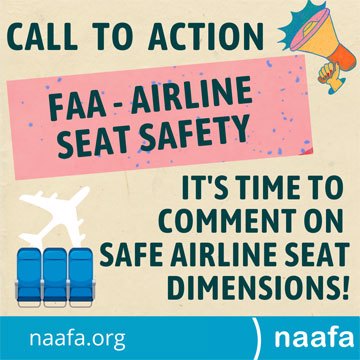
Send your comments on the rules for minimum dimensions for passenger seats no later than November 1, 2022.
In 2018, Congress directed the Federal Aviation Administration to issue rules for minimum airline passenger seat dimensions for passenger safety. The FAA then conducted simulated emergency evacuations, which relied on able-bodied adult subjects (no information provided about their size) under age 60. The FAA now invites public comments to assist the agency in determining what minimum dimensions of passenger seats are necessary for safety, including airplane evacuation. This includes pitch (distance between a point on a seat to the same point on the seat behind it), width, and length.
Comments should address whether one or more of the following seat dimensions have or demonstrably could adversely affect the safety of air passengers by delaying the group egress time of an emergency evacuation:
a. Seat width (current average seat width is 16.5");
b. Seat pitch (current average seat pitch is 31");
c. Seat length; and
d. Other seat dimensions.
The minimum seat dimensions to ensure safety should account for a broad range of passengers, including those who were not included in the CAMI study such as children, people over 60, and individuals with disabilities.
The FAA emphasizes that comments that include technical data and information will be the most helpful. The FAA is not requesting comments regarding how the dimensions of passenger seats might relate to passenger comfort or convenience. However, we do encourage you to think about how discomfort may impact your ability to safely evacuate a plane, and include such insights in your commentary as you see fit.
For your convenience we have written a Sample Comment. You may use it and add your personal experience/comment on your belief whether seat sizing and pitch may inhibit your ability to exit the plane quickly during an emergency evacuation.
Send comments identified by docket number FAA-2022-1001 using any of the following methods by November 1, 2022:
-
Federal eRulemaking Portal: Go to https://www.regulations.gov/commenton/FAA-2022-1001-0001 and follow the online instructions for sending your comments electronically.
-
Mail: Send comments to Docket Operations, M-30; U.S. Department of Transportation (DOT), 1200 New Jersey Avenue SE, Room W12-140, West Building Ground Floor, Washington, DC 20590-0001.
-
Hand Delivery or Courier: Take comments to Docket Operations in Room W12-140 of the West Building Ground Floor at 1200 New Jersey Avenue SE, Washington, DC, between 9 a.m. and 5 p.m., Monday through Friday, except Federal holidays.
-
Facsimile: Fax comments to Docket Operations at (202) 493-2251.
|
|
|---|
|
The Unlearning Series: Rewriting the Fat Body
Led by Vanessa Chica Ferreira
|
|
|---|
|
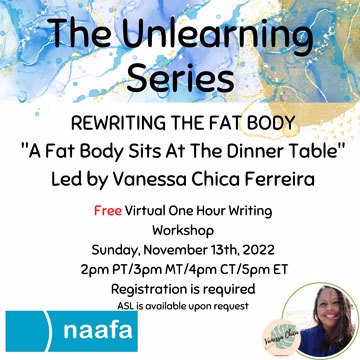 Sunday, November 13, 2022 at 2pm PT/3pm MT/4pm CT/5pm ET Sunday, November 13, 2022 at 2pm PT/3pm MT/4pm CT/5pm ET
Content warning: This series will include topics such as exploring negative feelings (our own and others).
Description of Event:
The "Unlearning Series" is a generative writing workshop, open to participants of all ages, sizes, and abilities. Participants will be led through writing prompts and activities to encourage inner and outer reflection on topics related to fat bodies. November's topic will be "A Fat Body Sits At The Dinner Table".
The Unlearning Series: Rewriting the Fat Body is for fat people and fat-positive folx of all sizes.
This webinar is presented via Zoom, in English, and with English auto-captions by Otter.ai. If you will need ASL interpreting, please register no later than 11/9/22 for us to arrange for ASL Interpreting by Pro Bono ASL.
Click here to register for this workshop. |
|
|---|
|
|
|
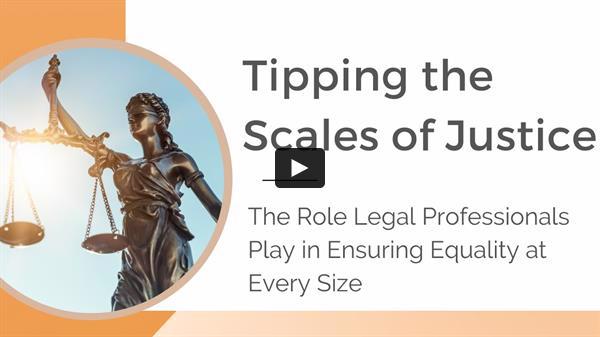
Tipping the Scales of Justice: The Role Legal Professionals Play in Ensuring Equality at Every Size
https://www.youtube.com/watch?v=tffqIL9rw1E&t=2s
On September 8, 2022, a panel of experts including NAAFA Chair, Tigress Osborn; NAAFA Board Member, Elaine Lee; Director of the FLARE Project, Brandie Solovay; and Moderator Nicholas Lawson discussed how anti-fatness is a form of systemic oppression that invades every aspect of U.S. and global culture and the important role legal professionals can play in: supporting the passage of Equality at Every Size legislation, the influence and power lawyers have in utilizing existing policies and laws to create fat justice, and the need for an intersectional approach to fighting anti-fatness. |
|
|---|
|
Health At Every Size and HAES are registered trademarks of the Association for Size Diversity and Health, and are used with permission.
|
|
|---|
|
|
|
|---|
|
|
Join Us at Fat Fridays Virtual Social Club! Event Is Free!
presented by NAAFA and hosted by Bree (@BreeIsHelpfulAF) |
|
|---|
|
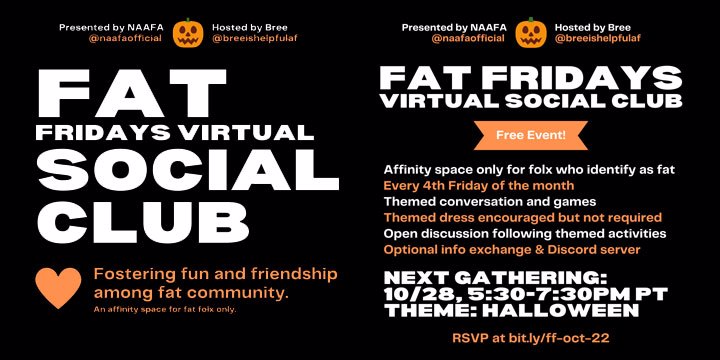
The Fat Fridays Social Club is held via Zoom and is an affinity space only for folx who identify as fat. (Ages 16+) Next gathering is 10/28, 5:30 - 7:30 PST
Each month has a theme. The theme for September is #Halloween. Here's what you can expect:
1. Introductions - Name, pronouns, location (learn the First Peoples of your location at native-land.ca)
2. Themed discussion about Halloween
3. Themed game - Halloween-themed Et Cetera! (Winner will choose next month's theme!)
4. Open social time
Themed dress is totally encouraged! (But not required.)
You must RSVP at bit.ly/ff-oct-22 |
|
|---|
|
Public Transit Survey Update
|
|
|---|
|
 NAAFA has been working with a group of leaders in the American Public Transportation Association (APTA) to conduct research for transit industry CEOs and Administrators to improve customer experience for fat and larger bodied people.
The APTA team presented their report to the APTA National Conference on October 9, 2022. Some of the specific audiences they targeted include the Diversity and Inclusion Council, Access Committee, and CEOs of mid-size agencies. They have also been asked to present to individual transit agencies across the nation after the conference. We are proud to have worked in conjunction with this team in providing much needed data to those in positions of authority to be able to make changes that will benefit fat community.
They have shared the results of the survey previously promoted in the NAAFA Newsletter and we are highlighting some of those findings here.
USE OF PUBLIC TRANSIT:
96% of respondents identified as fat, higher weight, large bodied or ob*se (respondent's preference)
37% had used public transit within the last month, 38% within the last year, 21% within the last 3 years and it had been more than 3 years for 4%
64% of respondents prefer to use a personal auto over public transit to travel in their area, with 69% of respondents having access to a personal vehicle
Of those with access to a personal vehicle, 56% would prefer to use public transit over a taxi/rideshare
COMFORT AND SAFETY ON PUBLIC TRANSIT:
14% stated that they felt very unsafe and very uncomfortable when using public transit, 48% said they felt unsafe and uncomfortable, 32% felt safe and comfortable, and 3% felt very safe and very comfortable
The vast majority of respondents do NOT believe seating works well for their body, nor are the rows spaced appropriately, with bench seats (without molded "seat scoops") with moveable arm rests being the better choice in types of seats.
CONVENIENCE, ACCESSIBILITY AND AFFORDABILITY OF PUBLIC TRANSIT:
39% of respondents felt that public transit was convenient for them, where 49% felt it was inconvenient for them
42% believe public transit to be accessible to them, while another 42% believe public transit to NOT be accessible to them
74% think that public transit is affordable, with 14% think it is NOT affordable
The majority of respondents look up information about seating, accessibility, wait times, fat inclusive policies on the internet prior to making a decision about traveling on public transit.
ATTITUDES AND ATMOSPHERE OF PUBLIC TRANSIT:
Employees are courteous: 47% agree, 16% disagree, 36% neither agree or disagree
I am valued as a customer: 19% agree, 33% disagree, 47% neither agree or disagree
I feel a sense of belonging: 18% agree, 51% disagree, 30% neither agree or disagree
78% of respondents have experienced on board public transit where they felt unsafe, uncomfortable or devalued
WHAT NEEDS IMPROVEMENT?
91% of respondents believe seating on board transit vehicles needs improvement
76% of respondents believe seating at transit stops and stations needs improvement
76% feel that the size of turnstiles need improvement
66% agree that body and or fat positive corporate culture (e.g. use of inclusive messaging and advertising) needs improvement
59% think availability of elevators and escalators needs improvement
56% believe ADA accessibility on board and at stops/stations needs improvement
49% believe that availability of trip planning information needs improvement
48% think availability of shelter from inclement weather needs improvement
44% feel frequency of transit service needs improvement
29% believe that customer service skills of transit employees need improvement |
|
|---|
|
We have a treat for this month's Chronicles entry: NAAFA's 81st newsletter from May 1987, A SPECIAL ISSUE: LETTERS WRITTEN BY NAAFA MEMBERS.
For more, check out the "Chronicles" page of the NAAFA website, https://naafa.org/chronicles.
|
|
|---|
|
|
by Tegan Lecheler, NAAFA Advocacy Committee Chair |
|
|---|
|
As the fall season ramps up, so too does our legislative advocacy work here at NAAFA. As our community is likely aware, there are currently no federal policies protecting fat people from discrimination and only two states (Michigan and Washington) have state level protections in place (In Washington State, ob*sity is covered under State Disability Law). Guided by NAAFA's past work helping get legislation passed in places such as San Francisco and Santa Cruz, and the wisdom of the Fat Legal Advocacy, Rights and Education (FLARE) Project, as well as fat activists around the world, we are currently leading policy campaigns in Massachusetts, New York State, and New York City. NAAFA is also collaborating with folks in New Jersey, where anti-weight discrimination legislation was introduced for consideration earlier this year. While we understand that legislation is not liberation, if even one person is able to keep their job, their housing, or access medical care because of this legislation, we believe it to be worthwhile. Given that people who are marginalized in other ways are more likely to be fat, we also feel that this is an important step towards economic, racial, ethnic, gender, and sexuality justice.
What Does the Legislation Say?
These bills, if (when!) passed, will make weight and height protected classes, meaning it will be illegal to discriminate against people for these individual metrics -- or any ratio of the two -- in employment, housing, and public accommodations. "Public accommodations'' includes public healthcare, which is an important piece of this legislation given the severity of weight discrimination in medical settings.
What's The Status of Legislation?
In Massachusetts, New Jersey, and New York, legislation has been introduced and is awaiting committee hearing dates. We expect dates in New Jersey this Fall, with dates in Massachusetts and New York in Winter 2022 or Spring 2023. In New York City, Councilman Sean Abreu introduced legislation in April, and it currently has 27 councillors signed on as co-sponsors. With so much support in the Council already, we also expect a hearing date in NYC soon!
What Can You Do to Support?
In order to pass legislation, we are going to need support from our community. There are many ways folks can help pass these historic bills.
If you live in NYS, NYC, NJ, or MA:
- If you're willing to testify about the importance of these protections, sign up using the form the Equality At Every Size page of our website (naafa.org/eaes).
- Get ready to write to your legislator vocalizing support. Find your representatives here. We'll be adding sample support letters to our website soon. Stay tuned.
- Talk to your neighbors and encourage them to write to their legislators as well!
No matter where you live:
- Follow us on social media @naafaofficial and encourage your friends to follow us!
Talk to your friends, family, and community! Spread the word, generate excitement, and encourage them to subscribe to our newsletter.
|
|
|---|
|
Anti-Racism Resources
Compiled by Darliene Howell
|
|
|---|
|
 |
This month we are looking at anti-discrimination and/or anti-racism legislation that has passed or is currently pending in the 117th Congress, which will end January 3, 2023. For the pending legislation, there is a link to information about who sponsored it, the actual text, and actions taken. It's important to be aware of our rights and how legislation can support us in our work to end racism. If you have questions or comments about a specific resolution, bill, or act, you can contact your Congressperson here or Senator here.
HISTORICAL - FEDERAL LAW
Title 42 USC, Chapter 21, Subchapter 1, Section 1981: Equal rights under the law
Title VII of the Civil Rights Act of 1964: Title VII prohibits employment discrimination based on race, color, religion, sex and national origin.
Voting Rights Act of 1965: The Voting Rights Act of 1965 (VRA) bans the denial or restriction of the right to vote and forbids discrimination in voting practices on the basis of race and color nationwide.
Title 42 USC, Chapter 3601, Section 801: Fair Housing Act - protection in housing on the federal level.
Title 15 USC, Section 1691(a): Equal Credit Opportunity Act - grants all applicants an equal opportunity to obtain credit through the anti-discrimination provision.
PENDING FEDERAL LEGISLATION
In the U.S., November is when you exercise one of the basic rights of being an American citizen by getting out and voting. But to do so, you need to register and prepare. At present the Voting Rights Act of 1965 is being placed in jeopardy. The Supreme Court heard a case earlier this month that continued the deconstruction of the historic law and could make it more difficult for minority voters to challenge alleged gerrymandering. You can make a difference by reading the pending bills and making your voice heard. Get out and vote for those that support you.
House Res. 4: John R. Lewis Voting Rights Advancement Act of 2021
Senate Bill 2747: Freedom to Vote Act
House Res. 5746: Freedom to Vote: John R. Lewis Act
House Res. 103: Condemns the bigotry that was displayed and voiced during the January 6th siege of the United States Capitol, the prominent role played by White supremacists and domestic terrorists in planning and leading the siege, and the elected officials who encouraged them.
Senate Bill 172 and House Res. 344: A resolution declaring racism a public health crisis.
House Res. 132: Recognizing people of African descent and Black Europeans.
House Res. 1727: Emmett Till and Will Brown Justice for Victims of Lynching Act of 2021.
Senate Bill 888 - CROWN Act of 2021: The CROWN Act, which stands for "Creating a Respectful and Open World for Natural Hair," is a law that prohibits race-based hair discrimination, which is the denial of employment and educational opportunities because of hair texture or protective hairstyles including braids, locs, twists or bantu knots.
ALLYSHIP
You can actively support anti-racism initiatives by being an accessory. Read the pending Congressional bills and contact your representatives to ensure the passage of legislation that will help break the cycle of oppression and safeguard everyone's civil rights.
|
|
|---|
|
Media and Research Roundup
by Bill and Terri Weitze
|
|
|---|
|
September 23, 2022: Weight stigma at a doctor's office can start from the moment a fat patient walks in the door, and continue with small blood pressure cuffs, small gowns, and healthcare professionals who prioritize weight loss over the actual symptoms of the patient.
https://www.vox.com/ad/23180916/weight-stigma-doctor-healthcare-patient-harm
October 2022: Volume 11, Issue 3 (2022) of
Fat Studies focuses on fat and fashion.
https://www.tandfonline.com/toc/ufts20/11/3
October 1, 2022: The FAA is being urged to revisit the issue of the size of seats on commercial airlines; as the average size of Americans gets bigger, the seats and space between seats continue to shrink.
https://news.yahoo.com/americans-larger-faa-stop-airplane-125741153.html
https://www.regulations.gov/commenton/FAA-2022-1001-0001
October 4, 2022: Semaglutide drugs being used for weight loss (Wegovy being the only one that is FDA approved for this purpose, all others are approved only for blood sugar control) seem effective up to a point (the amount of weight lost can vary greatly), but can yield some serious side effects, are expensive, and provide only temporary weight loss.
https://news.yahoo.com/weight-loss-drug-semaglutide-232810981.html
October 4, 2022: Posthumously, Mama Cass Elliot has received a star on the Hollywood Walk of Fame for her contributions to the recording industry.
https://www.upi.com/Entertainment_News/2022/10/04/Cass-Elliot-star-Hollywood-Walk-Fame-Mamas-Papas/1921664888905
October 5, 2022: Every year during fat bear week, you can vote for the plumpest bear in Alaska's Katmai National Park. Scientists find the process of bear hibernation fascinating on a metabolic level and fat bears could help us learn more about diabetes, muscle atrophy, inactivity, and evolution.
https://www.washingtonpost.com/wellness/2022/10/05/fat-bears-hibernation
October 12, 2022: A study finds that exercise might make fat cells "healthier" metabolically, with no need to change size or lose weight but by reducing the size of fat cells while increasing the number of fat cells.
https://www.washingtonpost.com/wellness/2022/10/12/exercises-to-shrink-fat-cells/
https://doi.org/10.1093/gerona/glab356 |
|
|---|
|
Founded in 1969, NAAFA, the National Association to Advance Fat Acceptance, is a non-profit human rights organization dedicated to improving the quality of life for fat people. NAAFA works to eliminate discrimination based on body size and provide fat people with the tools for self-empowerment through public education, advocacy, and member support.
On the web: https://naafa.org
Comments: pr@naafa.org
Newsletter Content Editors: Darliene Howell and Tigress Osborn
Newsletter Layout Editor: Bill Weitze
Any products or services mentioned in articles in this newsletter are for information only and should not be considered endorsements by NAAFA.
|
|
|---|
|
|
|