|
Our Websites
|
Our PC(USA) web page Our
official link on the PC(USA) website. More links here on ways to contribute financially to support us, pages for other Mission
Personnel, and other
ministries of the church.
Our blog, with musings, photos, links, and other digitized thoughts on our journey. We update this often, so check in regularly, or subscribe on the web page to get notified about updates.
|
|
A Time to Pray:
* Continued prayers for the displaced people of Piojó who are trying to gain claim to their land. They have to turn the papers into INCODER (part of the Department of Agriculture), and then they hear more about their chances to be land owners again in May.
* For theIPC and the Presbyterian Peace Fellowship as they plan a five-year review of the Accompaniment Program here in Colombia during Holy Week.
* For all those going to Ecumenical Advocacy Days in the hopes of asking our government to act justly and compassionately as it makes policies that affect millions of people around the world, including Colombia. Registration is still open if you want to join us.
* For Richard as he travels in Urabá Presbytery. He will be helping the Colegio Americano with their chaplaincy as well as taking a kick-his-butt bike ride with the Executive Secretary of the IPC.
* Prayers of thanksgiving for Park Presbyterian Church in Streator, IL and Westminster Presbyterian Church in Medford, OR. We just received word of their donation last week, and we had not even asked them for support! Sometimes folks are just grand.
* For Mamie as she tries to figure out how to offer a preaching workshop in Spanish for seminary students. She's up for resources and suggestions!
|
|
A Time
(and the way)
to Contact Us!
|
Mamie and Richard are on Facebook, Richard is on Twitter (rawillia13), and Mamie is on Skype (mamie.broadhurst). We are glad to be in touch!
|
|
In the book of Ecclesiastes (after Psalms, before Isaiah) there is a well-known passage (made perhaps more famous by the Byrds) in which we are told that for everything there is a season and a time for every matter under heaven. It covers pretty much everything I can think of and, depending on when I read it, I can find solace in the knowledge that what I am feeling is okay or that perhaps the time for balance has arrived.
As Lent has begun I have thought more and more about what this time of wilderness wandering holds. Preparations for many include the idea of "giving up something" - though often for reasons that sound more like a second chance at that failed New Year's Resolution than as a desire to focus more on Christ. For me, part of what I have realized is that Lent too is a season - a time in which the matter under heaven at the moment is the chance to review ourselves and our life of faith before coming to the epicenter of it all - the cross and the resurrection.
And to do that well, 40 days is probably not really enough. Thankfully we have this time every year, but the question is - what do we do with it? In Colombia I wait to see what will happen. We have just finished Carnaval (see below) which has been a series of parties and jubilation going on in some form or fashion since January. But that time has ended - and abruptly - with the burial of the Carnaval and the imposition of ashes (for the Roman Catholics among us...more on that here). I am anxious to see how the rest of the season plays itself out.
What I do know is that during Lent the church here will continue to pray that the "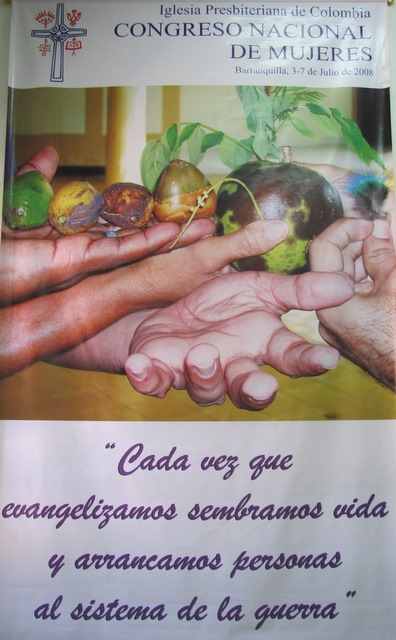 time for peace" will arrive sooner than later. They must, because how much longer can people read news stories of suitcases filled with body parts, of army members who kill people and dress them up as guerilla fighters to receive rewards, of rumors of war with Venezuela? The church here will continue to pray for "a time to love" - sharing with others the good news of Jesus Christ's love for us (whether by word or by deed or both) because as they note in the poster pictured here, "each time we share the good news we sew life and pull people out of the system of war." And I will continue to pray that my sisters and brothers here will get enough respite from death and fear that they will be able to mourn and to weep instead of just laugh and get on with it all. time for peace" will arrive sooner than later. They must, because how much longer can people read news stories of suitcases filled with body parts, of army members who kill people and dress them up as guerilla fighters to receive rewards, of rumors of war with Venezuela? The church here will continue to pray for "a time to love" - sharing with others the good news of Jesus Christ's love for us (whether by word or by deed or both) because as they note in the poster pictured here, "each time we share the good news we sew life and pull people out of the system of war." And I will continue to pray that my sisters and brothers here will get enough respite from death and fear that they will be able to mourn and to weep instead of just laugh and get on with it all.
We pray your Lenten reflections bring you challenge and comfort, hope and concern, compassion and impatience; for indeed everything to its season.
We have more stories and pictures on our blog, so please check in there as well:
As always, we appreciate your support and prayers. Blessings to all of you in this time of reflection, and remember you are always welcome to visit. We'll keep the light on for you. ;)
Peace ~
Mamie and Richard
If you want to add emails, there is a sign up form on our website. Please feel free to pass any information along! You can also unsubscribe at any time through a link at the bottom of this email.
|
Our Partners:
 
* Westminster Presbyterian Church of Odessa, TX |
A Time to Celebrate: What exactly is Carnaval?
The season of Carnaval just ended in Baranquilla, and life is finally slowing down a little. According to the official website, Carnaval of Barranquilla is a party given by Colombia for the whole world. It is a party of cumbias, porros, mapalés, gaitas, chandés, puyas, andangos, and merecumbés (all music/dances). It is a fiesta that gathers traditions based in the creativity of our people expressed through dance, music, artistry, costumes, and celebration. It is celebrated officially each year over the four days prior to Ash Wednesday (sort of like Mardi Gras), though the parties really begin in January.
Carnaval has a European origin, introduced to America by the Spanish and Portuguese, but the parties in Cartagena have their closest antecedents in the celebrations of Africans in Cartagena in the Colonial Era when they would go into the streets with typical instruments, special attire, dances, and singing. It is, however, a multi-cultural celebration, Indigenous, European, and African roots.
In the second half of the 19th C., Barranquilla became the principal city in the Caribbean region (due to its location near both the sea and the mouth of the Magdalena River), though there is not a precise date for the first Carnaval celebrated in the city. Arguable dates are anywhere from 1808 to 1903.
For photos from our limited experience with Carnaval, click here.
|
|