New Tax Savings for Homeowners
Two laws create perks for clean energy
The Residential Clean Energy Property Credit provides most of the biggest tax credits, which for the most part are unlimited. The Energy Efficient Home Improvement Credit offers other credits that tend to be capped, although the limits were raised starting in 2023.
(Note: The latest changes were made in December 2022. There is still outdated information on many websites, including on at least one page of the IRS website.)
Tax credit vs. deduction
Unlike a tax deduction, a tax credit is applied directly against any taxes you owe. This means that a $4,000 tax credit reduces the amount of taxes you pay by $4,000.
Link to the summary of energy tax credits
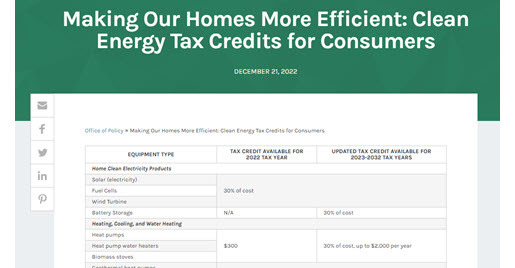
To see a quick summary of all the credits available in 2022, as well as the updated credits available from 2023 to 2032, click the link below or the image above.
Energy tax credits available from 2022 through 2032
Starting in 2022 and continuing through 2032, homeowners can get a tax credit in the amount of 30% of the cost of improvements such as solar energy for electricity, fuel cells, wind turbines, geothermal heat pumps, and solar for heating water.
There is no limit on these credit amounts, except in the case of fuel cells, which are restricted to $500 per half kilowatt of capacity.
New credits that started in 2023
This year marks the beginning of several new tax incentives, including an unlimited credit for 30% of the cost of battery storage. There are also new capped credits for 30% of the cost of electric panel or circuit upgrades and the cost of a home energy audit.
Credits that increased in 2023
There have been big increases in the credits provided for installing heat pumps, heat pump water heaters, and biomass stoves. In 2022 those credits were capped at $300, whereas from 2023 through 2032 the credit for each is 30% of the cost, with a limit of $2,000 per year.
More energy tax credits
Various other credits with capped dollar amounts are available for improvements such as:
- Efficient air conditioners
- Efficient heating equipment
- Efficient water heating equipment
- Windows and skylights
- Exterior doors
- Insulation materials
A home electric vehicle charger credit appears to be still under review. A footnote states that the credit will be intended for people in low income or non-urban areas.
Another change for 2022 returns
As of 2022, mortgage insurance is no longer allowed as a tax deduction. (To be clear, mortgage
interest is still deductible.) Conventional loan borrowers pay PMI, or Private Mortgage Insurance, as an additional part of their monthly payment when they have less than 20% equity in their home.
FHA and USDA loans have their own versions of mortgage insurance, both of which are also affected by this change.
Home appreciation can be used to remove PMI
Homeowners can use property appreciation to establish enough equity to get their mortgage insurance removed. There is an application process with the lender, who will usually request an appraisal to verify that the property has increased sufficiently in value to give the homeowner at least 20% equity.
(Mortgage insurance on USDA loans is permanent, and on FHA loans is permanent in many cases.)
|