Fall 2024 Housing Market Update
Home Prices Are Appreciating (A Bit More Slowly)
U.S. home prices increased by 4.3% between July 2023 and July 2024, according to CoreLogic, a data and analytics company. CoreLogic expects prices to increase by July 2025.
Notably, there was no home price increase between June and July of 2024, the first time that has happened since 2010 (except for July of 2022, when the market reacted sharply to interest rate increases).
Interest Rates Are Down
The 30-year fixed-rate mortgage average is currently hovering in the low 6% range. Since rising from a historic low of 2.65% in early 2021 it peaked at nearly 7.8% in late October of 2023, then hit a lower crest of 7.22% in May of this year.
Where Are Rates Headed?
The Federal Reserve is widely expected to lower the federal funds rate by a quarter point at its mid-September meeting. Opinions are mixed regarding how this may affect mortgage rates.
Some experts believe that mortgage rates will fall, while others feel that rates have already dropped in expectation of the upcoming Federal Reserve meeting. If the latter proves to be true, rates could stay the same or might even increase if the Federal Reserve pulls a surprise and doesn't drop the rate after all.
The Eastern U.S. Is Leading the Price Trend
After years of watching home prices tear upwards in west coast and mountain states, northeastern states are now experiencing some of the strongest home price appreciation rates in the country. Along for the ride are some regional outliers, including South Dakota and Nevada.
Click here to see the latest price map from CoreLogic (scroll down the page to view the map).
There's More Housing Inventory (Finally!)
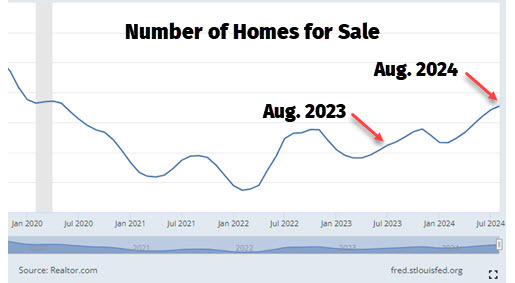
There were nearly 36% more homes for sale nationwide this August compared to a year ago, according to the Federal Reserve Bank.
The months of supply of existing homes for sale (a measure of how long the existing supply would last if no new listings were added) was at 4.0 months in July 2024.
Putting "Months of housing supply" in perspective:
The lower the number, the more of a seller's market it is. This indicator was at 3.3 months in July 2023, 1.6 months at its rock bottom low in January 2022, and 13 months going into the recession in 2008. Six months of supply is generally considered a balanced market.
Which States Had the Best Price Appreciation?
Rhode Island holds the crown this July, with year-to-year home price appreciation of 10.6%, according to CoreLogic. New Jersey was in second place at 9.7%, followed by Connecticut, South Dakota and Illinois at 8.3%, 8.1% and 7.5% respectively.
Consistent contenders in the top year-to-year home price appreciation category over the past several months have been Maine, New Hampshire, South Dakota, Rhode Island and New Jersey.
The cities with top annual gains in July were Miami (9.1%), Chicago (7.2%), and Las Vegas (7.0%), according to CoreLogic.
Expect the Election to Affect Fall Housing Activity
During presidential election years the housing market is usually subdued by consumer uncertainty.
Some proportion of would-be buyers and sellers postpone their plans until the following year in order to have a better idea of what to expect from the economy, and those actively in the market may be more cautious about assuming risk.
Housing Headlines Often Reflect an Older Market
News articles make real estate statistics sound as though they're a reflection of today's market, but most home sale data are based on closings that occurred one to three months previously.
The buyer decisions that determined the sale prices were made even earlier, at the time the offer was made (typically around 30 days before the closings). This means that housing news based on closed sales usually reflects the market environment as it was two to four months ago.
"Lower Sales" Doesn't Always Mean a Weaker Market
The headline "Home Sales Are Down" is often presented in a way that implies a softening housing market, but home sales are a measure of volume, not prices.
In a low-inventory market the volume of home sales can decrease while prices are being driven upward by bidding wars, whereas greater inventory can allow for higher sales volume (and a headline trumpeting that "Home Sales Are Up!") at the same time that home prices are dropping due to decreased competition.
|