What to Expect From the 2026 Housing Market
Experts Expect Moderate Price Growth
U.S. home prices increased by 1.0% nationwide between November 2024 and November 2025, according to Cotality (formerly CoreLogic), a data and analytics company.
Home prices decreased by .1% month-to-month in November 2025. A drop in price strength is typical at the end of the year, when the busy holiday season and shorter days take some home buyers out of the market.
In general, "cautious optimism" appears to be the outlook for 2026.
Cotality expects year-to-year home prices to increase by 4.3% by November. Zillow has a more moderate forecast of between 1.2% and 1.7%, while Realtor.com predicts a 2.2% bump upwards.
Rates Will Probably Stay Steady
While the general consensus is that the Federal Reserve will not drop the federal funding rate at its January 28 meeting, many financial experts expect mortgage rates to remain in the low 6 percent range this year.
The East and Midwest Are Leading Price Increases
Nine out of the ten hottest markets were in the East and Midwest in 2025, with price increases ranging from 7.7% in Decatur, Illinois to 13.6% in Youngstown, Ohio.
Nine out of the ten coolest markets were in the South and Southeast, ranging from -6.1% in Dalton, Georgia to -10.4% in Victoria, Texas.
Click here to see the data from Cotality (scroll down the page to view the map).
There Will Be More Housing Inventory
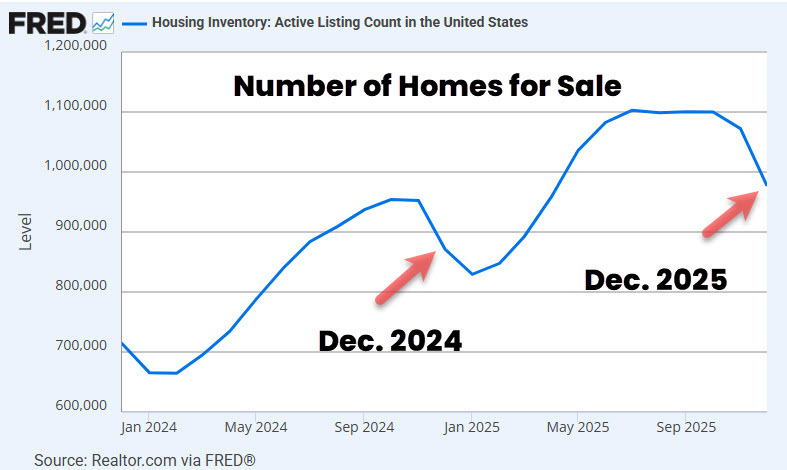
There were 12% more homes for sale nationwide in December 2025 compared to a year previously, according to the Federal Reserve Bank.
A common prediction for 2026 is that inventory will continue to increase, in part because "locked in" homeowners who have been putting off a move in order to hang on to their ultra-low mortgage rates may be more likely to venture back into the market now that rates have fallen.
Homes May Be More Affordable
Even though home prices are expected to go up moderately in 2026, a projected rise in housing inventory combined with favorable interest rates and year-to-year wage increases are expected to offset upward price trends. This should make home buying more affordable in 2026 compared to 2025.
Insurance Will Influence Home Buying Decisions
Fire and flooding hazards have created an unpredictable home insurance market, with insurers dropping or refusing coverage in more and more areas. Home buyers are increasingly taking insurance coverage into consideration when choosing locations for their future homes.
Housing Headlines Reflect an Older Market
News articles make real estate statistics sound as though they're a reflection of today's market, but most home sale data are based on closings that occurred one to three months previously.
The buyer decisions that determined the sale prices were made even earlier (at the time the offer was made - typically around 30 days before the closings). This means that housing news based on closed sales usually reflects the market of two to four months ago.
Tip: "Lower Sales" Doesn't Always Mean a Weaker Market
The headline "Home Sales Are Down" is often presented in a way that implies a softening housing market, but home sales are a measure of volume, not prices.
- In a low-inventory market the volume of home sales can decrease while prices are being driven upward by bidding wars.
- More inventory can allow for greater sales volume (and a headline trumpeting that "Home Sales Are Up!") when home prices are dropping due to decreased competition.
A general rule of thumb:
Shorter market times and/or bidding wars (even when home sale volume is down) mean that a market is heating up.
Increasing market times and/or price reductions (even when home sale volume is up) are indicators of a cooling market.
|