December 2020 NAAFA Newsletter |
|
|
Santa and Stigma: Thoughts on the Thinning of a Fat Icon
by Tigress Osborn, NAAFA Director of Community Outreach |
|
|
 |
In many ways, it makes no difference to me what size Santa Claus is. Generally, I operate by a principle I learned from my friend and fellow activist Marilyn Wann, who I'm paraphrasing when I say that I don't care what people weigh; what I care about is how they think and behave about weight. I understand that St. Nicholas has some historical roots. I also understand that contemporary Santa can be many things to many people. I'm invested in historical accuracy in many areas of life. Being a Santa fan is not one of them. I say bring on Santas of all sizes, all races, all genders! Whether that's retelling the Santa story, casting actors to be mall Santas, or dressing yourself up as the world's most recognizable jolly fat guy, I think the Santa story should be accessible to folx from many walks of life in whatever ways bring them joy and help them spread joy. I love Santas!
But there is only one kind of Santa experience I cannot abide. There is no room in my life for Body Shame Santa Stories.
My first experience with Santa being stigmatized was in my elementary school's 6th grade musical. The music teacher chose
Shapin Up Santa, the tale of Mrs. Claus sending Santa off to fat camp because she was worried about his health. Tortured by Betty Body, an overzealous exercise instructor with a crew of assistants clad in leg warmers and leotards, Santa was subjected to something akin
Biggest Loser until he and his elf BBF tried to make a break for it. I played Tony, the pizza delivery guy, who shows up with 10 pizzas for Santa to eat solo in the "look what fat people will do if someone thin doesn't reign them in" final scene of the play.
Sixth grade me never thought about whether it was mean or inappropriate or damaging to Santa to enroll him in Betty Body bootcamp. I was just sad they let a 5th grade boy play Santa instead of me just because "Santa can't be a girl." (Grown-up me, however, wonders how it was ok for me to play the Italian pizza delivery guy.) Looking back, I'm appalled that the adults in my school thought it was appropriate for 11-year-olds to do an entire show of song and dance numbers centered around forcing someone to change his body against his will.
Since that trip down Body Shame Lane in 1985, I've seen everything from good natured jokes about eating lots of cookies to downright awful jokes about the grossness of Santa's body. This year, I sat down to watch one of the Netflix holiday hits I missed last year (
The Christmas Chronicles) and was looking forward to Kurt Russell as Santa. It never even occurred to me that he was a thinner Santa until the script kept hitting me with "jokes" at me about how The Real Santa works out and isn't a fat slob like the fake Santa on billboards. How much internalized fatphobia does a writer have to have to turn a cute holiday movie about some kids meeting Santa into an opportunity to remind the world that Santa would be superior if he had tighter abs?
Every December we're given mixed messages--we should love this jolly fat man, but we should not enjoy enough holiday treats to end up looking like him. These messages matter tremendously. The way we talk about Santa's body is important, especially when we're talking to kids. Even for fat people who don't celebrate Christmas, Santa's ubiquitousness makes him one of the most recognizable fat people on Earth. Fat visibility in media can affirm or contradict cultural messages, and it can also help create them. When Santa's fat is presented as positive or even neutral, we're reminded that fat does not have to be stigmatized and demonized.
But healthism and "obesity epidemic" fears continue to underscore our messages about fat, pressuring culture creators to show Santa as health-conscious. And when diet culture is mainstream culture, health-conscious means thin or trying to be thinner. If we embrace diverse depictions of Santa, there's nothing wrong with thin depictions of Santa, just like there's nothing wrong with thin people. Like I said, the more Santas the merrier!
But there's also nothing wrong with fat Santa. He doesn't need to be fixed. He doesn't need to slim down. No one needs holiday healthism or Christmas concern trolls. I ho-ho-hope that any Santas you encounter this season have a twinkle in their eyes and generosity in their heart (and a festive holiday mask because 2020 needs that from Santa). And I hope Santas who spread body shame and bullies who harass fat Santas all end up with stockings full of coal!
|
|
|
December Anti-Racism Resources
|
|
|
26 Mini-Films for Exploring Race, Bias and Identity With Students
The New York Times produced this 2017 series of mini-films that range in time from 1 to 7 minutes and cover issues of race, bias and identity in America. The series was developed to help teachers address racism but can also help individuals and families in understanding and talking about race and racism. |
|
|
|
|
Health At Every Size and HAES are registered trademarks of the Association for Size Diversity and Health, and are used with permission.
|
|
|
|
|
|
|
2020 - A Year in Review
by Darliene Howell
|
|
|
 |
I think everyone would say that 2020 has been a very eventful year. Although it has been a very tough year for many, we have also seen people connecting in ways we may not have considered previously, giving us hope.
Organizationally, I believe that NAAFA has helped our members and fat community as a whole to deal with the chaos. We have worked to support and combat the negative effects of 2020 with positive change.
- NAAFA's introduction of Spanish-translations of our educational brochures has broadened the outreach of fat acceptance to Spanish-speaking people across the world.
- The Future of NAAFA Committee was formed and has been instrumental in defining and implementing many of our new programs and initiatives.
- NAAFA introduced our new website, org, making it mobile-friendly.
- We increased the number of programs in the NAAFA Webinar Series. We continue to expand the inclusion of intersectional presenters, which give fat community more options for learning and connecting to others during the pandemic.
- The establishment of the Fat Community Fund Mini-Grant Program encourages individuals to create projects that further educate fat people or the general public about fat rights.
- NAAFA has deepened our commitment to being an anti-racist organization and is working to demonstrate that commitment in our policies and programs.
- We invited the addition of new Board of Directors members and broadened the Board with four new members: Amanda Cooper, Marcy Cruz, Kathryn Hack, and Elaine Lee. Tigress Osborn, NAAFA Community Outreach Director, accepted the position as the Chair of the Board Elect and will assume the office as the Chair on January 1, 2021.
- As an extension of the new website, we created the NAAFA Community Voices Blog and have opened it to guest bloggers from fat community.
We certainly did not do all these things alone. We give our heartfelt thanks to:
- The Future of NAAFA Committee
- Our webinar guests
- The guest writers for our new blog
- All the volunteers who donate time, energy and skills to keep NAAFA going and growing
- All members and contributors to NAAFA for their financial support
The events of 2020 have affected the entire world. Yet we continue to be hopeful for what will come in 2021.
As a reminder, you still have time to receive a tax deduction for 2020 by donating to NAAFA at https://naafa.org/joindonate and help us continue to implement positive changes. You may donate to the general fund and/or a special programming fund and help make NAAFA better in 2021. Every gift counts!
|
|
|
Special Announcement: Changes to NAAFA Facebook Groups
|
|
|
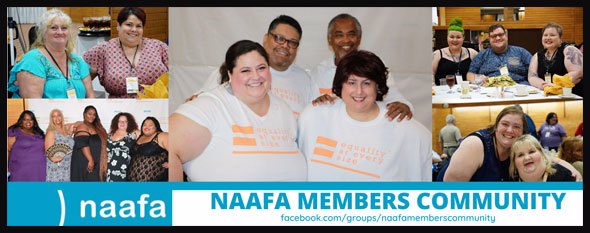
After careful consideration and analysis of how our current Facebook groups are being used, the NAAFA Board of Directors has decided to archive all NAAFA Facebook groups that are organized by location. We believe that those who are truly interested in engagement and discussion with the NAAFA community would be better served by one Facebook group for NAAFA members.
We invite you to join the newly created NAAFA Members Community group at https://www.facebook.com/groups/naafamemberscommunity, where we will continue to post updates and where you are encouraged to interact with fellow NAAFA members.
We welcome you to continue following NAAFA on our main Facebook page. We also remind you that our monthly newsletter is free to all interested parties regardless of NAAFA membership, as are our NAAFA Webinar Series and Community Voices Blog.
In fat solidarity,
The NAAFA Board of Directors
|
|
|
 |
Here we are in the middle of a holiday season in the middle of a pandemic. Disappointment is high. Pressure is high. Stress is on overdrive. Holiday advertising began way before Thanksgiving. Santa Claus, holiday decorations, gifts, gatherings, masks and physical distancing consume our thoughts and overshadow reason. For some, the loss of a job or lack of money are making an oftentimes difficult situation even worse.
Women assume a lot of responsibility during this season. With others to care and provide for and so much to do, it is important that you take care of yourself to avoid becoming sick. It's impossible to have that holiday of everyone's dreams this year; we really need to protect ourselves and our loved ones by being extra careful.
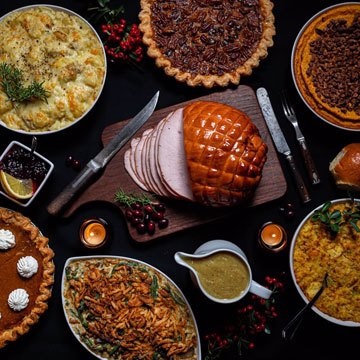
One thing that overwhelms our senses starting with Thanksgiving and extending through the New Year is food; flavorful, rich, hearty winter food
. Most of us are blessed to be surrounded by way more yummy food than we need. Some struggle with their desire to over indulge. For all of us, balance is the key. Finding balance is not always easy, but you are worth the effort.
I mentioned carving out time for self-care and this is essential. Make sure you get adequate sleep each night. Everyone's needs differ, but the National Institutes of Health recommend that adults get 7-8 hours per night. Bad sleep habits and long-term sleep loss will negatively impact your health.
Food is fuel for the human body. It provides us with the energy we need to accomplish all our holiday tasks. Learn to pay attention to your hunger cues. It doesn't matter what the clock says, when your body lets you know it is low on fuel, feed it.
Twenty minutes of "you time" each day can restore your sanity and renew your energy for the rest of your busy day. Find a safe, quiet place, take some deep breaths, listen to soothing music and try to clear your mind. When stress has you strung out, take that twenty-minute break instead!
If you celebrate holidays this season that include feasting with loved ones in your household, give yourself permission to eat what you'd like. When we give ourselves permission to enjoy food, we remove those feelings of guilt that only result in even more stress!
So, in summary, my advice for surviving the holiday season with your sanity intact is: get an adequate amount of sleep each night, eat when your body says it's time to refuel, take 20 minutes of "me time" each day, don't drink the WHOLE bottle of wine and give yourself permission to enjoy that holiday feast. You'll feel better for it.
|
|
|
Media and Research Roundup
by Bill and Terri Weitze
|
|
|
Founded in 1969, NAAFA, the National Association to Advance Fat Acceptance, is a non-profit human rights organization dedicated to improving the quality of life for fat people. NAAFA works to eliminate discrimination based on body size and provide fat people with the tools for self-empowerment through public education, advocacy, and member support.
Any products or services mentioned in articles in this newsletter are for information only and should not be considered endorsements by NAAFA.
|
|
|
|
|


 The Voice