|
|
|
Dear VPF Friends,
Welcome to the Violence Prevention Forum newsletter. We share research, resources, upcoming events and opportunities on a bi-weekly basis. We hope you find this a useful and valuable resource.
For any resources and events you'd like to share in this newsletter or queries, contact vpf@issafrica.org. You can also stay up to date with opportunities and research on our linkedIn page here
|
|
|---|
|
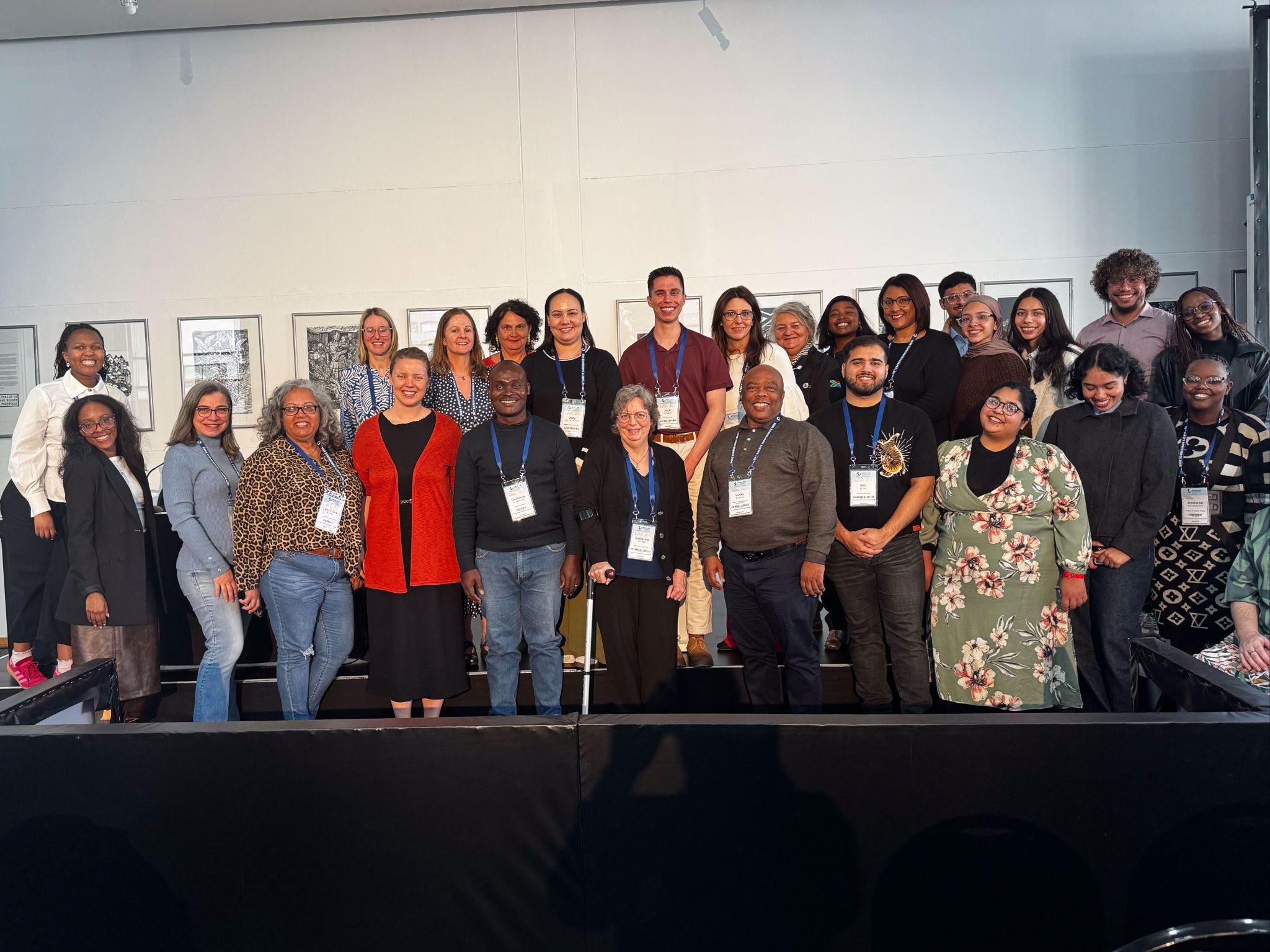 |
VPF at the 16th World Conference on Injury Prevention and Safety Promotion
The 16th World Conference on Injury Prevention and Safety Promotion (Safety 2026), held in Cape Town from 1–4 September, brought together researchers, practitioners and policymakers from an estimated 80 countries. Under the theme #UbuntuUnitedForASaferFuture, the conference highlighted the interconnectedness — our safety is tied to the safety of others.
The timing of the conference was significant. 2026 marks the 30th anniversary of the WHO Resolution declaring violence a public health priority. Yet despite this recognition, violence and injury remain major global public health issues, claiming an estimated 4.4 million lives every year, most heavily in low- and middle-income countries. The need for a whole-of-society approach is clear, but effective implementation at scale has been a challenge. Collaboration can look easy on paper but is much harder in practice.
The Institute for Security Studies (ISS) presented the Violence Prevention Forum (VPF) as a model for bridging research, practice and policy. The team opened with a question: "What if the missing ingredient is not data, but trust?" Lessons from the Forum show that collaborations often overlook power dynamics and histories of conflict between civil society, government and researchers, which shape how partners show up and their incentives to participate. A poster shared how the VPF flattens hierarchies, treating researchers not as experts but as equal participants alongside NGOs — encouraged to share their work in accessible language, with dedicated time for sensemaking. The Hoekwil–Touwsranten community dialogue was shared as a local example of how sustained dialogue builds relationships across difference and supports community-led safety initiatives. ISS also co-facilitated a side event on the INSPIRE framework, the globally recognised approach with the strongest evidence for addressing violence against children.
Moving from evidence to action, the team argued, requires a rethink of what stands in the way of collaboration — that the missing ingredient is often not data or coordination, but trust. Sometimes the needed intervention is relationship-building itself.
|
|
|---|
|
|
Call for video submissions: Missing voices
Voices from communities, children and those working directly to prevent violence against children are not always represented in global decision-making spaces. Missing Voices, a multimedia project led by the Coalition for Good Schools, the Institute for Security Studies (ISS) and Raising Voices, aims to bring a diversity of voices, languages and contexts into the conversation ahead of the Second Global Ministerial Conference to End Violence Against Children in Manila in November 2026.
The project invites people to record a one-minute video responding to the question: “If you could tell leaders ONE THING about violence against children, what would it be?” Submissions can focus on violence or prevention at school, at home, in the community or online. Artwork, photographs, letters and poems can also be submitted. The collection will be showcased at the conference and may also be shared through the partners’ social media channels.
|
|
|---|
|
|
 |
VPF Featured as WHO Case Study Ahead of Second Global Ministerial Conference
The Violence Prevention Forum (VPF) has been shared by the World Health Organisation as one of 12 global case studies on what works to prevent violence against children. It is featured on their website as a resource ahead of the Second Global Ministerial Conference to End Violence Against Children, taking place in Manila in November 2026. The case study documents the VPF's model of multi-sectoral collaboration and its role in strengthening violence prevention practice in South Africa.
This is a significant moment for South Africa, the global South, and the Forum. It affirms the VPF's approach, built on flattened hierarchies, shared values, and sustained relationship-building across sectors, as a credible, evidence-informed model for systems change and enabling countries to move from evidence to action. The case study traces the Forum's evolution since 2015, including its contribution to South Africa's National Strategic Plan for Gender-Based Violence and Femicide, the emergence of the South African Parenting Programmes Implementers Network (SAPPIN), and its expansion into the Western Cape.
The case studies are primarily intended for government ministers, policymakers, and technical delegations attending the Conference, as well as practitioners, researchers, and donors working on violence prevention worldwide.
|
|
|---|
|
|
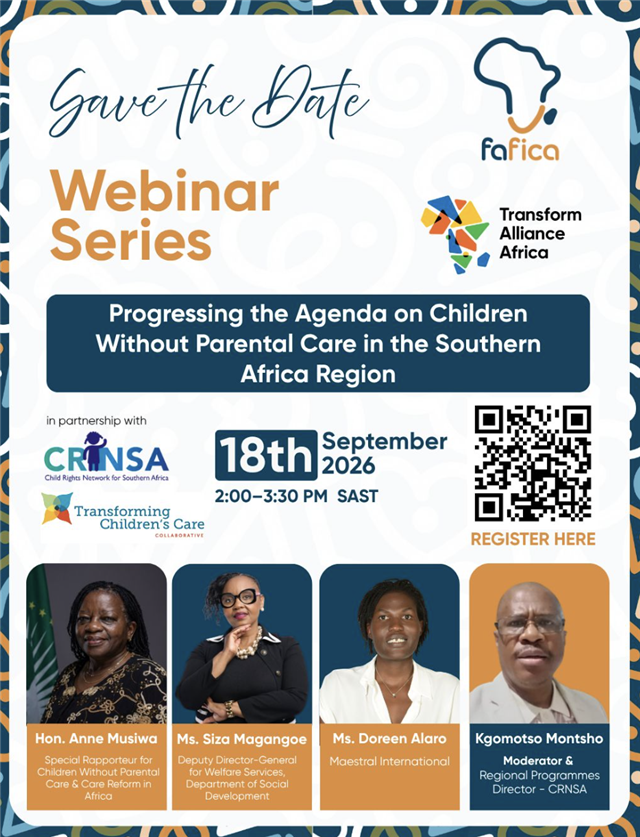 |
Webinar: Progressing the Agenda on Children Without Parental Care in the Southern Africa Region
Across Africa, millions of children are growing up without consistent parental care, facing challenges linked to poverty, conflict, displacement, family separation, abandonment, harmful practices and other forms of vulnerability. Yet Africa has a powerful foundation to build on: its long-standing traditions of family, community, belonging and shared responsibility for children. The priority is to strengthen these foundations so that families and communities are better equipped to prevent separation, respond to vulnerabilities and ensure children grow up in safe, loving and supportive family environments.
Join the Southern Africa Regional Webinar: Progressing the Agenda on Children Without Parental Care, convened by the Child Rights Network for Southern Africa (CRNSA), Transform Alliance Africa (TAA) and the Family First Alliance for Children Without Parental Care in Africa (FAFICA). The webinar will explore progress across the region, ongoing pressures on families and the practical actions needed to strengthen families, communities and child protection systems.
Date: 18 September 2026
Time: 14:00- 15:30 (SAST) |
|
|---|
|
|
 |
Call for Proposals: Western Cape Department of Social Development 2026
The Western Cape Department of Social Development is inviting eligible non-profit organisations to apply for funding to deliver social welfare and community development services across the province. The 2026 Call for Proposals covers the 2027/28–2029/30 funding cycle and includes programmes focused on care and services to families, child care and protection, after-school care, social crime prevention, victim empowerment, substance abuse, youth development and sustainable livelihoods, among others.
The call provides an important opportunity for organisations working with children, families and communities to contribute to the delivery of social services and prevention-focused interventions. Organisations are encouraged to review the relevant programme specifications, eligibility criteria and application requirements before submitting their proposals.
Applications are open from 3 August and close on 18 September 2026 at 16:00. Refer to the Frequently Asked Questions - 2026 Call for Proposals for application details.
Closing date: 18 September 2026
|
|
|---|
|
|
Research paper: Survivor-reported impacts of mandatory reporting of intimate partner violence against women, a systematic review
Mandatory reporting of intimate partner violence is intended to protect survivors and support access to justice, but concerns remain about its potential unintended consequences. A new systematic review examines these impacts from the perspectives of survivors themselves, drawing on 28 studies involving 14,540 adults.
The review found that survivors reported harms associated with mandatory reporting, including retaliatory violence, psychological distress and barriers to seeking care. Concerns were also raised about confidentiality and survivors’ ability to make decisions about disclosure and seeking justice. The findings highlight the importance of survivor-centred approaches that protect autonomy while providing access to support.
|
|
|---|
|
|
| |
| |
|
View this email in your browser
You are receiving this email because of your relationship with Violence Prevention Forum @ the Institute for Security Studies. Please reconfirm your interest in receiving emails from us. If you do not wish to receive any more emails, you can unsubscribe here.
|
|
|
|
|