|
|
|
Dear VPF Friends,
Welcome to the Violence Prevention Forum newsletter. We share research, resources, upcoming events and opportunities on a bi-weekly basis. We hope you find this a useful and valuable resource.
For any resources and events you'd like to share in this newsletter or queries, contact vpf@issafrica.org. You can also stay up to date with opportunities and research on our linkedIn page here
|
|
|---|
|
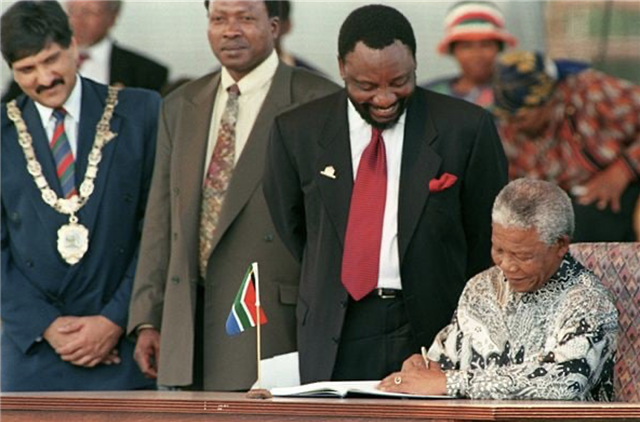
Seminar: South Africa’s constitution at 30, from promise to practice
Thirty years since South Africa adopted its post-apartheid constitution and transformative bill of rights, the gap between promise and lived reality remains wide. Inequality, unemployment and violence persist, while anti-immigrant protests and declining public trust in institutions reflect a populace dissatisfied with the country’s trajectory.
In just over a month, local government elections will provide a barometer of South Africa’s political and economic governance. Speakers at this seminar will take stock of the past 30 years and discuss how to strengthen democracy and promote accountability.
Space for in-person attendance is limited to the first 100 people who reply.
Date: 6 October 2026
Time: 09:00 – 13:00 (SAST)
Venue: The Capital Menlyn Maine, Pretoria, Zoom (in-person RSVP to close on 30 September or as soon as 100 places filled)
|
|
|---|
|
|
 |
Opinion piece: How disinformation networks amplify online xenophobia in SA
Social media can amplify real concerns about unemployment, crime, housing and public services, while directing frustration towards particular groups. This article draws on research by Tales of Turning showing how anti-foreign-national narratives can be amplified through coordinated online networks, making it harder to distinguish organic public sentiment from artificially amplified content. The research analysed a random sample of publicly available social media posts from 30 May to 30 June 2026 and found that 27% of the anti-foreign-national narrative analysed was linked to a disinformation network.
The article explores how emotionally charged content and repeated messages can reinforce fear and hostility, while genuine social grievances can be redirected towards particular groups. It points to the importance of recognising when legitimate frustration is being exploited and strengthening our ability to identify harmful narratives before they contribute to further division or real-world harm
|
|
|---|
|
|
Call for video submissions: Missing voices
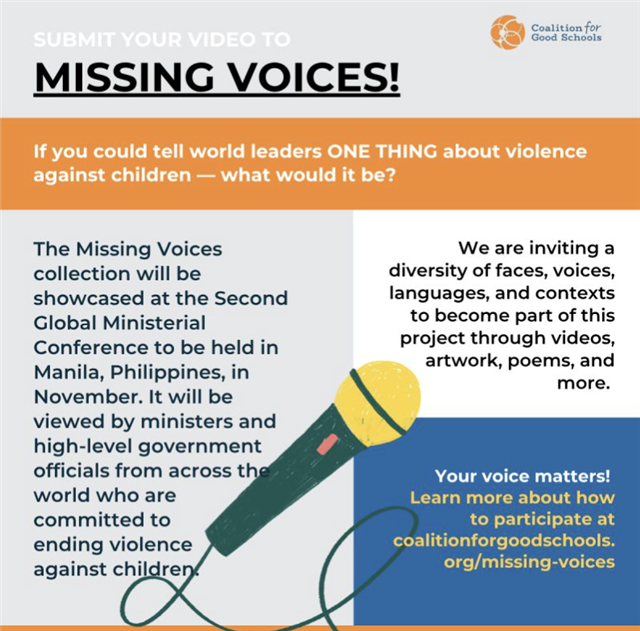
Voices from communities, children and those working directly to prevent violence against children are not always represented in global decision-making spaces. Missing Voices, a multimedia project led by the Coalition for Good Schools, the Institute for Security Studies (ISS) and Raising Voices, aims to bring a diversity of voices, languages and contexts into the conversation ahead of the Second Global Ministerial Conference to End Violence Against Children in Manila in November 2026.
The project invites people to record a one-minute video responding to the question: “If you could tell leaders ONE THING about violence against children, what would it be?” Submissions can focus on violence or prevention at school, at home, in the community or online. Artwork, photographs, letters and poems can also be submitted. The collection will be showcased at the conference and may also be shared through the partners’ social media channels.
|
|
|---|
|
|
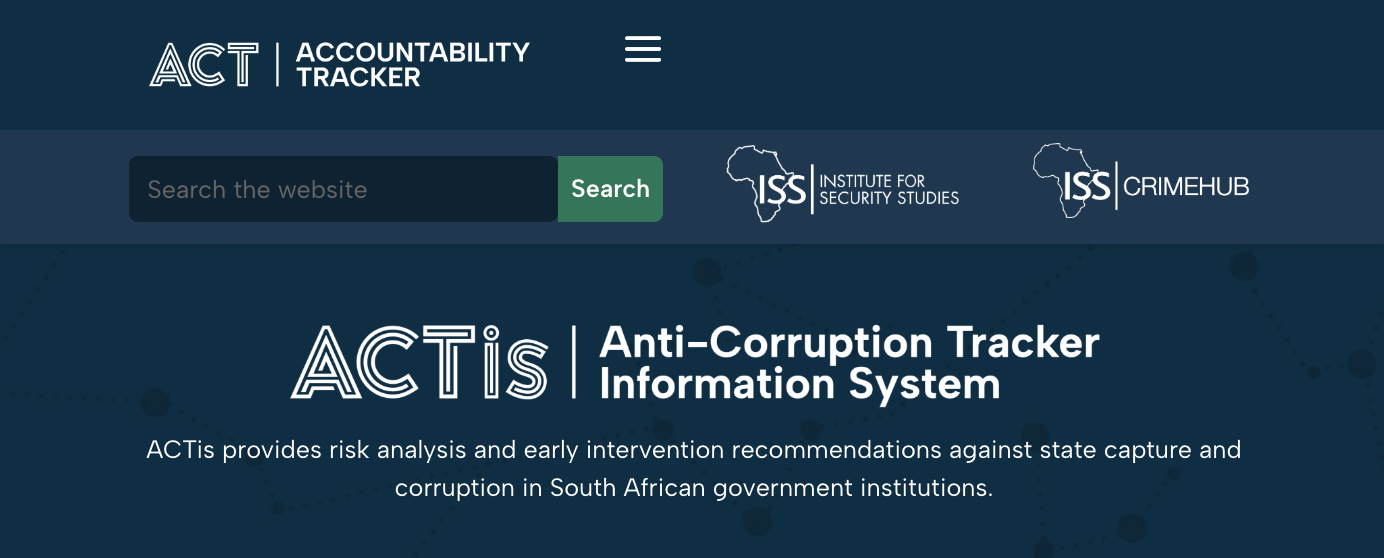 |
ACTis — the Anti-Corruption Tracker Information System
South Africans still experience consequences of acting too late against state capture and systemic corruption. The Judicial Commission of Inquiry into Allegations of State Capture, Corruption and Fraud in the Public Sector including Organs of State (‘Zondo Commission’) showed how networks of public and private actors progressively compromised institutions, weakened oversight and diverted public resources. The ongoing work of the Judicial Commission of Inquiry into Criminality, Political Interference and Corruption in the Criminal Justice System (‘Madlanga Commission’) reminds us that state capture was not a ‘once-off’ project and that we need credible ways to identify emerging risks and intervene before corrupt practices and networks become entrenched, as promoted by the N ational Anti-Corruption Strategy.
To fill this gap, the Institute for Security Studies are pleased to introduce ACTis — the Anti-Corruption Tracker Information System. Developed as part of the ISS’ Anti-Corruption and Accountability Project, ACTis is an early intervention system that identifies patterns associated with state capture and systemic corruption within specific government institutions. By consolidating and analysing a wide range of disaggregated public information, ACTis offers duty-bearers and civil society actors an evidence-informed foundation to act sooner to protect our institutions.
ACTis does not measure national corruption prevalence or determine criminal liability. Instead, it translates the hard-won lessons of the Zondo Commission into a forward looking capability that detects emerging institutional risks early enough to prevent them from becoming entrenched. It uses a nine-flag analytical framework to identify recurring patterns associated with institutional capture or systemic corruption. |
|
|---|
|
|
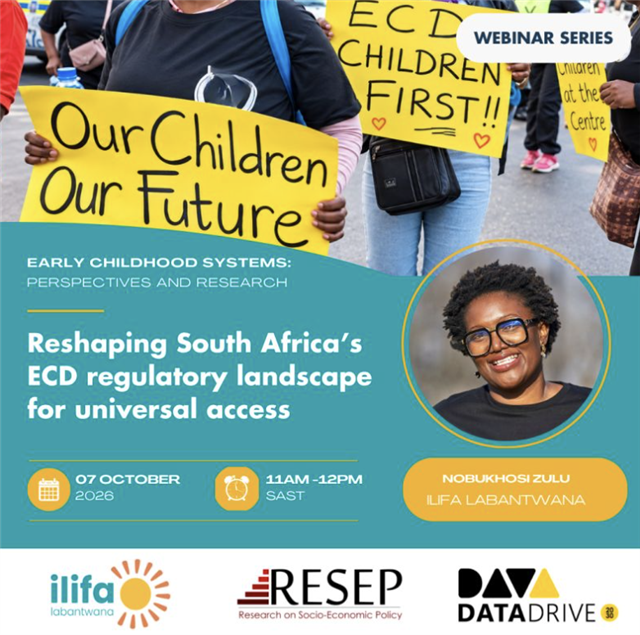 |
Webinar: Reshaping South Africa's ECD regulatory landscape for universal access
For many ECD programmes, navigating registration and compliance requirements remains a significant challenge. Yet access to quality early learning depends on creating a system that is both protective and enabling.
This webinar explores how the Children's Amendment Bill, the National Environmental Health Norms and Standards, and municipal guidelines are working together to create an enabling environment that protects children while making it easier for ECD providers to join and participate in the formal system.
In this session, participants will explore:
- How developmental regulation can support and recognise diverse ECD programmes.
- Practical, context-sensitive standards that promote child safety and quality improvement.
- The removal of barriers that have excluded many programmes and children from the system.
- The evolving role of municipalities in enabling ECD provision.
Date: 7 October 2026
Time: 11:00-12:00 (SAST) |
|
|---|
|
|
 |
Call for papers: Making Child Protection a Winnable Battle, Reimagining Investment, Upstream Prevention, and Multisectoral Action
Child abuse and neglect are among the most consequential and preventable public health challenges worldwide, with effects that extend across children’s health, education, relationships, economic opportunity and wellbeing. Yet child protection systems remain largely focused on responding after harm has occurred. This special issue calls for a shift towards upstream prevention, sustainable investment and approaches that strengthen families, communities and systems before harm occurs.
The special issue, “Making Child Protection a Winnable Battle: Reimagining Investment, Upstream Prevention and Multisectoral Action,” invites research, policy analysis, implementation studies, economic analyses, practice innovations and perspectives on prevention, coordinated investment and response, multisectoral systems, mental health and resilience, data and evidence, scaling what works, and equity and cultural norms. It aims to move the conversation beyond documenting what is wrong with child protection towards demonstrating what can be done differently and at scale
Submission deadline: 31 December 2026
|
|
|---|
|
|
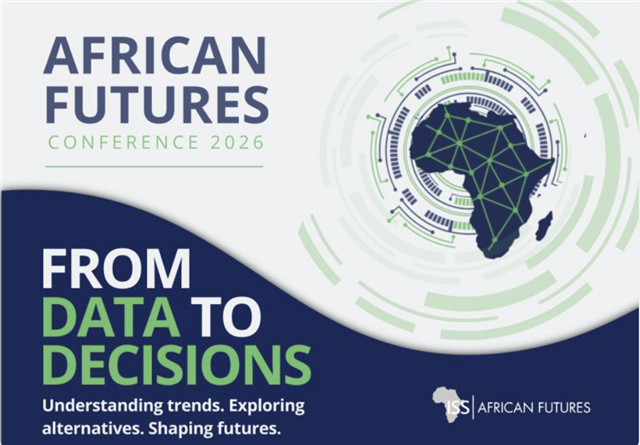 |
African Futures Conference 2026: from data to decisions
The African Futures Conference is the continent’s premier platform for African-led foresight. Now in its third year, the 2026 conference brings together policymakers, researchers, development practitioners, private-sector leaders and civil-society actors from across Africa and beyond, for two days of strategic dialogue, practical learning and continent-wide participation.
The theme From Data to Decisions traces an arc from evidence to action: understanding the trends shaping Africa's trajectory, exploring the futures that different choices could create and shaping the decisions that build a more inclusive, sustainable future.
The conference aims to strengthen the connection between data, foresight and decision-making for Africa's development. It showcases how evidence, modelling and scenario thinking can be applied in practice to inform more inclusive, sustainable and resilient policy, investment and strategic choices. The event elevates the voices of young changemakers alongside established leaders and researchers, encouraging intergenerational dialogue and stronger links between evidence generation and policy action across the continent.
Date: 13-14 October 2026
Time: 08h30 – 17h30 (GMT+2)
Venue: Hybrid (Day 1 in-person at the CSIR International Convention Centre, Pretoria + livestream | Day 2 fully online) |
|
|---|
|
|
 |
Research paper:Trends in child homicides in South Africa, evidence from three national surveys: 2009, 2017, and 2020/2021
Violence against children is a global public health problem, and despite the scarcity of data in low and middle-income countries, African children are reported to experience the highest levels of violence. Not much is known about child homicide, the most severe form of violence against children. Using data from three national surveys, the study explore trends in child homicide rates and cause of death by age and sex over time.
The study estimates that 1,018 children were murdered in 2009, 893 in 2017 and 948 in 2020/2021. While the overall homicide rate decreased slightly over the period, rates declined among children aged 0–4 while increasing among older children aged 15–17, with firearm-related deaths increasing among older boys between 2017 and 2020/2021. The authors emphasise the need for coordinated, multisectoral violence prevention strategies, stronger gun-control enforcement and improved investigative capacity and accountability. |
|
|---|
|
|
| |
| |
|
View this email in your browser
You are receiving this email because of your relationship with Violence Prevention Forum @ the Institute for Security Studies. Please reconfirm your interest in receiving emails from us. If you do not wish to receive any more emails, you can unsubscribe here.
|
|
|
|
|