|
|
|
Dear VPF Friends,
Welcome to the Violence Prevention Forum newsletter. We share research, resources, upcoming events and opportunities on a bi-weekly basis. We hope you find this a useful and valuable resource.
For any resources and events you'd like to share in this newsletter or queries, contact vpf@issafrica.org. You can also stay up to date with opportunities and research on our linkedIn page here
|
|
|---|
|
ISS Today: Preventing gender-based violence means protecting those most at risk
The first South African National Gender-Based Violence Study, released by the Human Sciences Research Council (HSRC) in 2024, found that women with disabilities were roughly twice as likely to experience lifetime sexual violence from a partner (14.6%) as women without disabilities (7.2%).
In August, a woman who uses a wheelchair was allegedly raped in her Khayelitsha home by four young men. She had done everything women are told to do – not out alone, not jogging on a quiet road, not in a taxi. She had not been drinking. She was inside her own house with her five-year-old son.
Women with disabilities in South Africa are roughly twice as likely as other women to experience lifetime sexual violence from a partner (14.6% vs 7.2%), according to HSRC research. |
|
|---|
|
|
ISS Today: SA elections, young South Africans aren’t apathetic – they are alienated
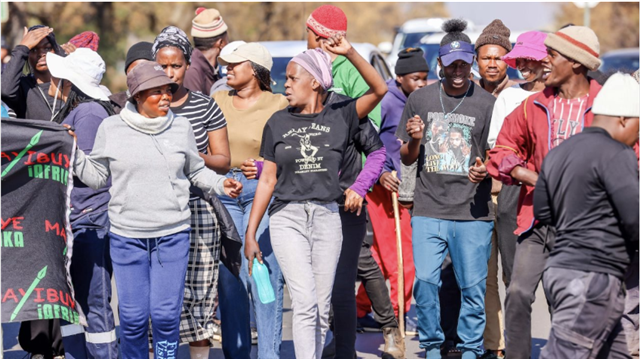
Ahead of SA’s 4 November local elections, ISS research in Ekurhuleni and eThekwini reveals deep alienation among young people who feel ignored by politicians and local government. Yet this disengagement doesn’t mean withdrawal from public life. Youth still volunteer in community policing, healthcare and other initiatives.
But their frustration enables exploitation by movements like March and March, who redirect their anger towards foreign nationals. Across many democracies, alienated young people are turning to those who offer someone to blame. SA must avoid deepening this trend. Young people need to be heard and included in decisions affecting them – not merely courted before elections. |
|
|---|
|
|
Webinar: Do protection orders protect women in South Africa?
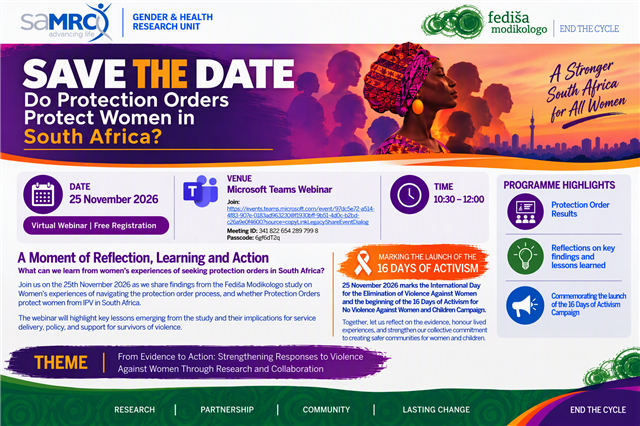
Join SAMRC and the Gender & Health Research Unit as they share findings from the Fediša Modikologo study on women's experiences navigating the protection order process, and whether protection orders protect women from intimate-partner violence.
This webinar will highlight key lessons emerging from the study and their implications for service delivery, policy, and support for survivors of violence.
Date: 25 November 2026
Time: 10:00-12:00 (SAST)
|
|
|---|
|
|
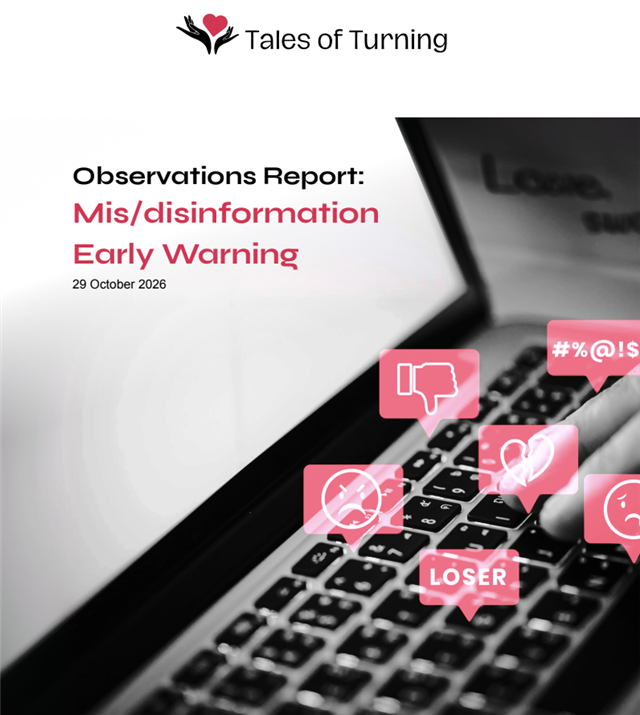 |
Observations Report: Mis/disinformation Early Warning
This observations report examines online conversations surrounding South
Africa’s electoral context leading up to the local government elections on 4
November 2026. The aim is to observe public social media discourse across key
societal friction points such as crime, the economy, immigration, and governance
to establish an early-warning system for potential disinformation. By gathering
data across these topics, the report identified societal fault lines and emotional
triggers that mis/disinformation networks can exploit.
The findings point to a digital environment where real social frustrations regarding unemployment, exclusion and crime provide opportunities for misinformation, inflammatory rhetoric, allegations of electoral fraud, and campaigns encouraging voting boycotts. Observations of public social media reveal warning signs that online electoral conversations are vulnerable to being influenced by hyper-active accounts and bot networks that manufacture outrage and simulate fake consensus. The risks of mis/disinformation include undermining the IEC, de-legitimising electoral processes, us-versus-them social divisions and increased voter apathy. |
|
|---|
|
|
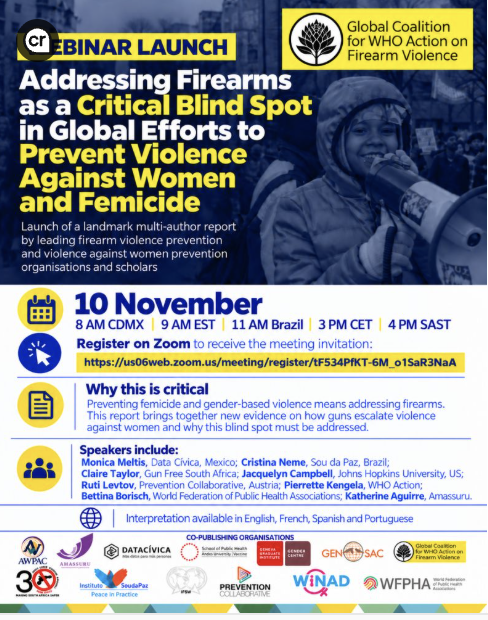 |
Webinar: Addressing Firearms as a critical blind spot in Global efforts to prevent violence against women and femicide
Join the Global Coalition for WHO Action on Firearm Violence for the launch of the landmark global report on firearms, violence against women and femicide. The report argues that firearms are a critical, overlooked driver of femicide and gender-based violence globally. Drawing on evidence from Brazil, Mexico, the Western Balkans, and South Africa, it shows firearms sharply increase lethality, enable coercive control, and are underrepresented in WHO, UN Women, and Women, Peace and Security frameworks despite WHO’s existing public health mandate.
Health systems often identify at-risk women before femicide occurs, but firearm removal and regulation remain inconsistently enforced. The report calls on the World Health Organization to integrate firearm risk into surveillance, clinical guidance, and prevention frameworks like RESPECT and INSPIRE, without duplicating arms-control agencies’ work.
Date: 10 November 2026
Time: 16:00 (SAST)
|
|
|---|
|
|
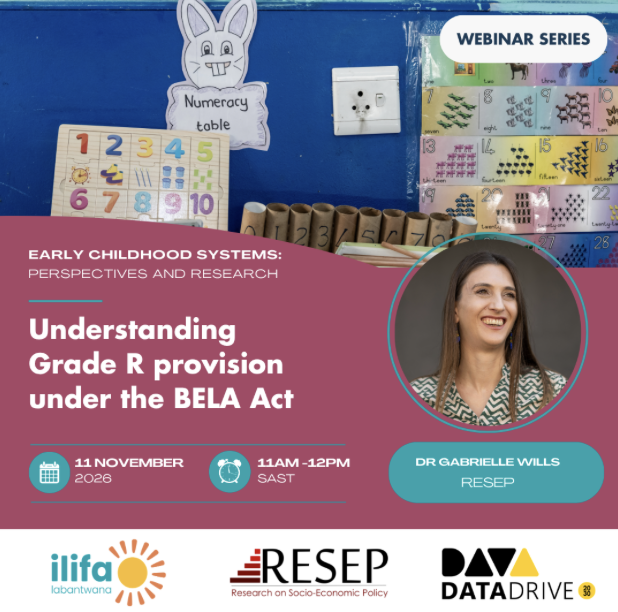
Webinar: Understanding Grade R provision under the BELA Act
The Basic Education Laws Amendment (BELA) Act makes Grade R attendance compulsory and officially incorporates it into the formal schooling system. The policy raises important questions about its impact on the early learning sector.
Join Ilifa labantwana, RESEP (Research on Socio-Economic Policy) and DataDrive2030 as they unpack the evidence, examine the risks, and explore how South Africa can strengthen access to quality early learning without undermining the existing mixed-provision system.
Date: 11 November 2026
Time: 11:00-12:00 (SAST)
|
|
|---|
|
|
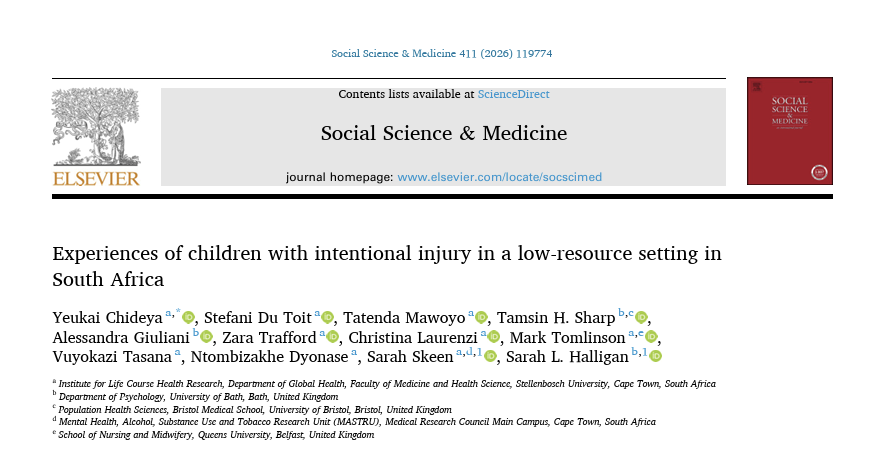
Research paper: Experiences of children with intentional injury in a low-resource setting in South Africa
Childhood exposure to violence in South Africa is extremely high. Despite alarming rates of intentional injuries among children, there is limited research on their experiences. This study explored the lived experiences of children who were intentionally injured in a low-resource setting in South Africa.
Results indicated that most injuries were inflicted by other children, arising from peer-group conflicts, exacerbated by a perceived need to show strength among boys. Most children experienced a lack of support from people who witnessed the incident, resulting in significant delays in accessing medical treatment. Immediate responses from families often prioritised retaliation/confronting the perpetrators before seeking medical care for children. Participating children also described mixed experiences within the hospital, including supportive care and perceived judgmental attitudes. |
|
|---|
|
|
| |
| |
|
View this email in your browser
You are receiving this email because of your relationship with Violence Prevention Forum @ the Institute for Security Studies. Please reconfirm your interest in receiving emails from us. If you do not wish to receive any more emails, you can unsubscribe here.
|
|
|
|
|